
Join Our JEE Preparation Group
Prep with like-minded aspirants; Get access to free daily tests and study material.
Sign in
Please select an account to continue using cracku.in
↓ →
Join Our JEE Preparation Group
Prep with like-minded aspirants; Get access to free daily tests and study material.
In order to oxidise a mixture of 1 mole each of $$\text{FeC}_2\text{O}_4$$, $$\text{Fe}_2(\text{C}_2\text{O}_4)_3$$, $$\text{FeSO}_4$$ and $$\text{Fe}_2(\text{SO}_4)_3$$ in acidic medium, the number of moles of $$\text{KMnO}_4$$ required is :
Step 1:
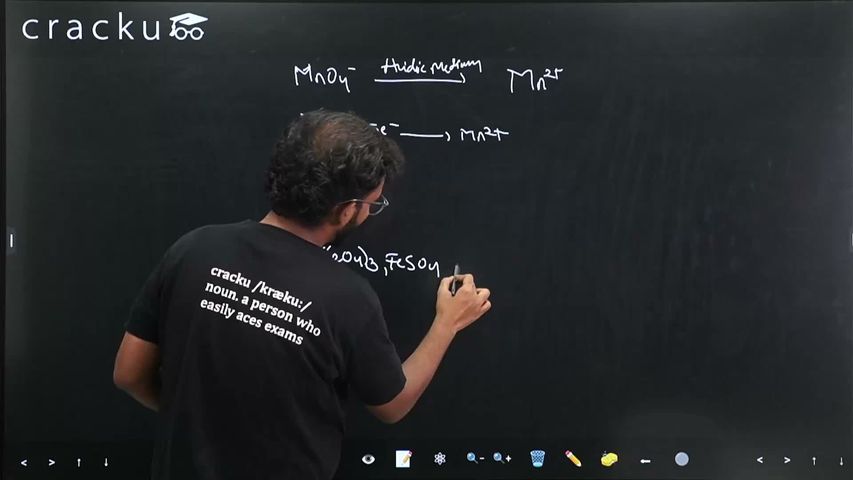
The reduction half-reaction for permanganate in acidic medium:
$$MnO_4^-$$ + $$8H^+$$ + $$5e^-$$ $$\rightarrow\;$$ $$Mn^{2+}+4H_2O$$
Every mole of $$\text{KMnO}_4$$ therefore accepts $$5$$ electrons.
Step 2:
Now find how many electrons are released when the given mixture is completely oxidised.
Iron centres
Fe is present as $$\text{Fe}^{2+}$$ in $$\text{FeC}_2\text{O}_4$$ and $$\text{FeSO}_4$$, and as $$\text{Fe}^{3+}$$ in $$\text{Fe}_2(\text{C}_2\text{O}_4)_3$$ and $$\text{Fe}_2(\text{SO}_4)_3$$.
• $$\text{Fe}^{2+} \rightarrow \text{Fe}^{3+} + e^-$$ (loss of one electron)
Number of $$\text{Fe}^{2+}$$ moles = 1 (from $$\text{FeC}_2\text{O}_4$$) + 1 (from $$\text{FeSO}_4$$) = 2
Electrons released by iron = $$2 \times 1 = 2$$
Step 3:
Oxalate ions
In acidic medium $$\text{C}_2\text{O}_4^{2-}$$ is oxidised to $$2\,\text{CO}_2$$:
$$\text{C}_2\text{O}_4^{2-} \rightarrow 2\text{CO}_2 + 2e^-$$
Each oxalate ion therefore releases 2 electrons.
Moles of oxalate ions present:
• 1 from $$\text{FeC}_2\text{O}_4$$
• 3 from $$\text{Fe}_2(\text{C}_2\text{O}_4)_3$$
Total oxalate moles = $$1 + 3 = 4$$
Electrons released by oxalate = $$4 \times 2 = 8$$
Step 4:
Total electrons released by the mixture
$$2 (\text{from Fe}) + 8 (\text{from oxalate}) = 10$$
Moles of $$\text{KMnO}_4$$ required
Since each mole of $$\text{KMnO}_4$$ accepts 5 electrons,
$$\text{Moles of } \text{KMnO}_4 = \frac{10 \text{ electrons}}{5 \text{ electrons per mole}} = 2$$
Hence, the number of moles of $$\text{KMnO}_4$$ needed is 2.
Option B $$=>$$ $$2$$
Was this solution helpful?
Click on the Email ☝️ to Watch the Video Solution
Create a FREE account and get:
_1.webp)

Educational materials for JEE preparation

Ask our AI anything

AI can make mistakes. Please verify important information.
AI can make mistakes. Please verify important information.


