
Join Our JEE Preparation Group
Prep with like-minded aspirants; Get access to free daily tests and study material.
Sign in
Please select an account to continue using cracku.in
↓ →
Join Our JEE Preparation Group
Prep with like-minded aspirants; Get access to free daily tests and study material.
In the estimation of bromine, $$0.5$$ g of an organic compound gave $$0.40$$ g of silver bromide. The percentage of bromine in the given compound is ______ % (nearest integer)
(Relative atomic masses of Ag and Br are 108u and 80u, respectively).
Correct Answer: 34
We need to find the percentage of bromine in an organic compound given that 0.5 g of the compound produced 0.40 g of silver bromide.
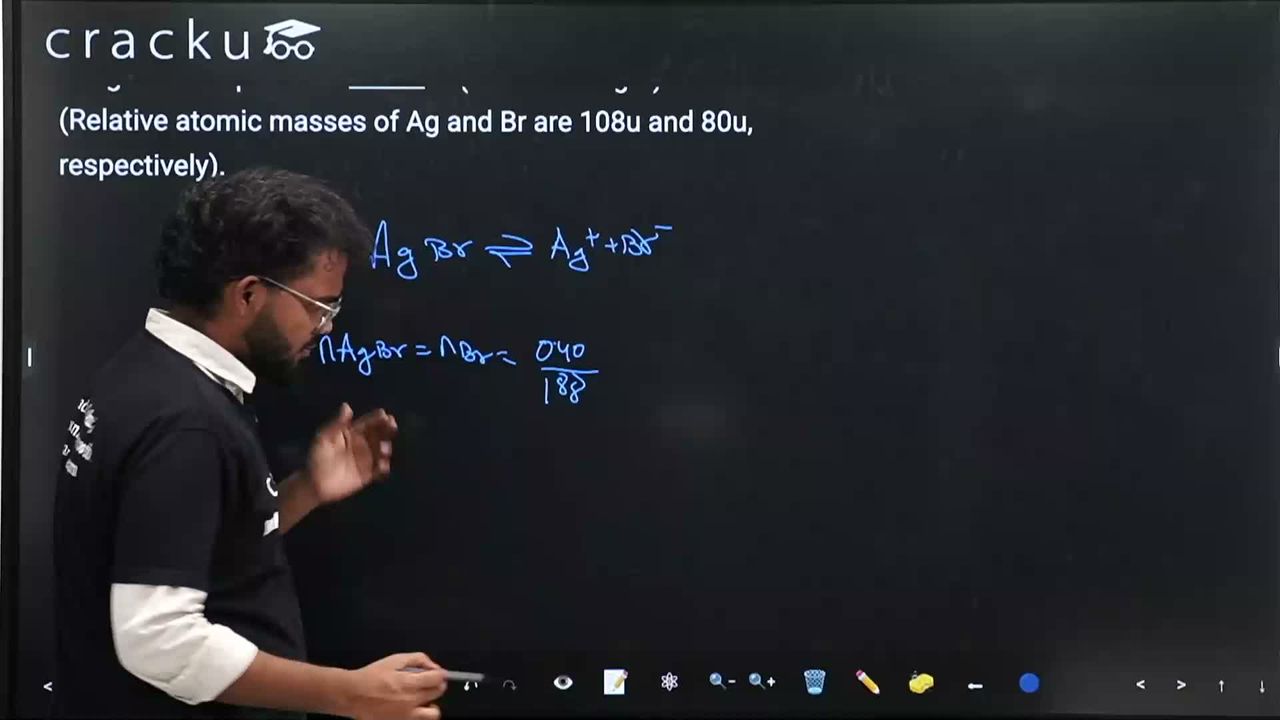
The molar mass of AgBr is $$M_{AgBr} = M_{Ag} + M_{Br} = 108 + 80 = 188 \text{ g/mol}$$.
The number of moles of AgBr formed is $$\text{Moles of AgBr} = \frac{0.40}{188} \text{ mol}$$. In the Carius method, all bromine is converted to AgBr, and since each molecule of AgBr contains one atom of Br, the number of moles of Br is the same: $$\text{Moles of Br} = \frac{0.40}{188} \text{ mol}$$.
The mass of bromine is calculated as $$\text{Mass of Br} = \text{Moles of Br} \times M_{Br} = \frac{0.40}{188} \times 80$$ which gives $$\text{Mass of Br} = \frac{32}{188} = 0.1702 \text{ g}$$.
The percentage of bromine in the compound is then $$\% Br = \frac{\text{Mass of Br}}{\text{Mass of compound}} \times 100 = \frac{0.1702}{0.5} \times 100 = 34.04\%$$, which rounds to 34 %.
Therefore, the correct answer is 34 %.
Was this solution helpful?
Click on the Email ☝️ to Watch the Video Solution
Create a FREE account and get:
_1.webp)

Educational materials for JEE preparation

Ask our AI anything

AI can make mistakes. Please verify important information.
AI can make mistakes. Please verify important information.
