
Join Our JEE Preparation Group
Prep with like-minded aspirants; Get access to free daily tests and study material.
Sign in
Please select an account to continue using cracku.in
↓ →
Join Our JEE Preparation Group
Prep with like-minded aspirants; Get access to free daily tests and study material.
In a reaction $$A + B \to C$$, initial concentrations of A and B are related as $$[A]_0 = 8[B]_0$$. The half lives of A and B are 10 min and 40 min respectively. If they start to disappear at the same time, both following first order kinetics, after how much time will the concentration of both the reactants be same?
For a first-order reaction the half-life is related to the rate constant by
$$t_{1/2} = \frac{0.693}{k}$$
Rate constants
For reactant $$A$$:
$$k_A = \frac{0.693}{t_{1/2\,(A)}} = \frac{0.693}{10\,\text{min}} = 0.0693\,\text{min}^{-1}$$
For reactant $$B$$:
$$k_B = \frac{0.693}{t_{1/2\,(B)}} = \frac{0.693}{40\,\text{min}} = 0.017325\,\text{min}^{-1}$$
First-order concentration expressions
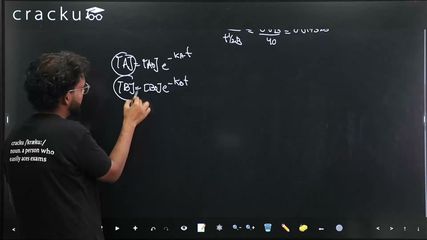
$$[A] = [A]_0\,e^{-k_A t}$$
$$[B] = [B]_0\,e^{-k_B t}$$
The initial concentrations are related by
$$[A]_0 = 8[B]_0$$ $$-(1)$$
We need the time $$t$$ at which the instantaneous concentrations become equal:
$$[A] = [B]$$ $$-(2)$$
Substitute $$(1)$$ and the exponential expressions into $$(2)$$:
$$[A]_0\,e^{-k_A t} = [B]_0\,e^{-k_B t}$$
$$8[B]_0\,e^{-k_A t} = [B]_0\,e^{-k_B t}$$
Cancel $$[B]_0$$ to obtain
$$8\,e^{-k_A t} = e^{-k_B t}$$
Take natural logarithm on both sides:
$$\ln 8 - k_A t = -k_B t$$
Rearrange for $$t$$:
$$\ln 8 = (k_A - k_B)\,t$$
Insert numerical values:
$$\ln 8 = \ln 2^3 = 3\ln 2 = 3(0.693) = 2.079$$
$$k_A - k_B = 0.0693 - 0.017325 = 0.051975\,\text{min}^{-1}$$
Therefore
$$t = \frac{2.079}{0.051975} \approx 40\,\text{min}$$
Hence, the concentrations of $$A$$ and $$B$$ become equal after $$40$$ minutes.
Option D.
Was this solution helpful?
Click on the Email ☝️ to Watch the Video Solution
Create a FREE account and get:
_1.webp)

Educational materials for JEE preparation

Ask our AI anything

AI can make mistakes. Please verify important information.
AI can make mistakes. Please verify important information.


