
Join Our JEE Preparation Group
Prep with like-minded aspirants; Get access to free daily tests and study material.
Sign in
Please select an account to continue using cracku.in
↓ →
Join Our JEE Preparation Group
Prep with like-minded aspirants; Get access to free daily tests and study material.
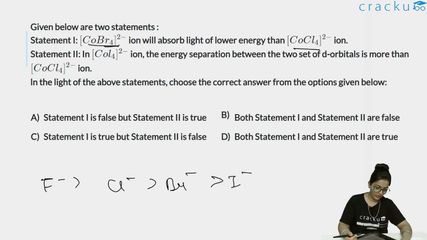
Given below are two statements :
Statement I: $$[CoBr_{4}]^{2-}$$ ion will absorb light of lower energy than $$[CoCl_{4}]^{2-}$$ ion.
Statement II: In $$[Col_{4}]^{2-}$$ ion, the energy separation between the two set of d-orbitals is more than $$[CoCl_{4}]^{2-}$$ ion.
ln the light of the above statements, choose the correct answer from the options given below:
In a tetrahedral complex, the splitting of the d-orbitals is denoted by $$\Delta_{t}$$. The energy of light absorbed, $$E_{\text{abs}}$$, is directly proportional to this splitting:
$$E_{\text{abs}} \propto \Delta_{t} \quad-(1)$$
Also, the wavelength of light absorbed, $$\lambda_{\text{abs}}$$, is inversely proportional to the energy absorbed:
Ligand field strength for halides follows the order:
$$\text{F}^{-} \gt \text{Cl}^{-} \gt \text{Br}^{-} \gt \text{I}^{-}$$
This means chloride is a stronger field ligand than bromide, and bromide is stronger than iodide.
Analysis of Statement I:
Statement I claims that $$[CoBr_{4}]^{2-}$$ absorbs lower energy light than $$[CoCl_{4}]^{2-}$$.
Since $$\Delta_{t}(\text{Cl}^{-}) \gt \Delta_{t}(\text{Br}^{-})$$ by the ligand field series, then by (1):
$$E_{\text{abs}}(\text{Cl}^{-}) \gt E_{\text{abs}}(\text{Br}^{-})$$
Hence $$[CoBr_{4}]^{2-}$$ indeed absorbs lower energy light compared to $$[CoCl_{4}]^{2-}$$.
Therefore, Statement I is true.
Analysis of Statement II:
Statement II claims that in $$[CoI_{4}]^{2-}$$ the splitting $$\Delta_{t}$$ is greater than in $$[CoCl_{4}]^{2-}$$.
From the ligand field series, $$\Delta_{t}(\text{Cl}^{-}) \gt \Delta_{t}(\text{I}^{-})$$.
This contradicts Statement II. Therefore, Statement II is false.
Combining these results: Statement I is true and Statement II is false. Hence the correct answer is Option C.
Was this solution helpful?
Click on the Email ☝️ to Watch the Video Solution
Create a FREE account and get:
_1.webp)

Educational materials for JEE preparation

Ask our AI anything

AI can make mistakes. Please verify important information.
AI can make mistakes. Please verify important information.
