
Join Our JEE Preparation Group
Prep with like-minded aspirants; Get access to free daily tests and study material.
Sign in
Please select an account to continue using cracku.in
↓ →
Join Our JEE Preparation Group
Prep with like-minded aspirants; Get access to free daily tests and study material.
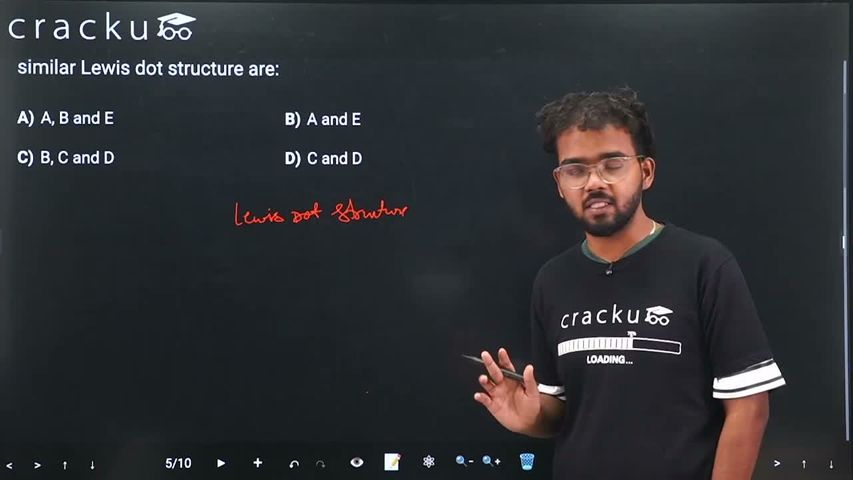
The pairs among
$$A = [SO_3^{2-}, CO_3^{2-}]$$, $$B = [O_2^{2-}, F_2]$$, $$C = [CN^-, CO]$$, $$D = [NH_3, H_3O^+]$$ and $$E = [MnO_4^{2-}, CrO_4^{2-}]$$ that do not have similar Lewis dot structure are:
Species having the same number of atoms and the same total number of valence electrons are isoelectronic and generally possess similar Lewis dot structures.
For the pair ([SO_3^{2-},,CO_3^{2-}]),
$$SO_3^{2-}:6+3(6)+2=26\ \text{valence electrons},$$
$$CO_3^{2-}:4+3(6)+2=24\ \text{valence electrons}.$$
Since the total number of valence electrons is different, their Lewis dot structures are not similar.
For the pair ([O_2^{2-},,F_2]),
$$O_2^{2-}:2(6)+2=14\ \text{valence electrons},$$
$$F_2:2(7)=14\ \text{valence electrons}.$$
Both are isoelectronic and therefore have similar Lewis structures.
For the pair ([CN^-,,CO]),
$$CN^-:4+5+1=10\ \text{valence electrons},$$
$$CO:4+6=10\ \text{valence electrons}.$$
Both are isoelectronic and possess similar Lewis dot structures.
For the pair ([NH_3,,H_3O^+]),
$$NH_3:5+3(1)=8\ \text{valence electrons},$$
$$H_3O^+:6+3(1)-1=8\ \text{valence electrons}.$$
Both have the same electron count and similar trigonal pyramidal Lewis structures.
For the pair ([MnO_4^{2-},,CrO_4^{2-}]), although both contain tetrahedral oxyanions, the central atoms have different electronic configurations. In (MnO_4^{2-}), manganese is in the (+6) oxidation state with a (d^1) configuration, whereas in (CrO_4^{2-}), chromium is in the (+6) oxidation state with a (d^0) configuration. Hence, their Lewis dot structures are not considered similar.
Therefore, the pairs that do not have similar Lewis dot structures are A and E.
Hence, the correct answer is A and E.
Was this solution helpful?
Click on the Email ☝️ to Watch the Video Solution
Create a FREE account and get:
_1.webp)

Educational materials for JEE preparation

Ask our AI anything

AI can make mistakes. Please verify important information.
AI can make mistakes. Please verify important information.


