
Join Our JEE Preparation Group
Prep with like-minded aspirants; Get access to free daily tests and study material.
Sign in
Please select an account to continue using cracku.in
↓ →
Join Our JEE Preparation Group
Prep with like-minded aspirants; Get access to free daily tests and study material.
Metal deficiency defect is shown by $$Fe_{0.93}O$$. In the crystal, some $$Fe^{2+}$$ cations are missing and loss of positive charge is compensated by the presence of $$Fe^{3+}$$ ions. The percentage of $$Fe^{2+}$$ ions in the $$Fe_{0.93}O$$ crystals is ______ (Nearest integer)
Correct Answer: 85
In the crystal $$Fe_{0.93}O$$, some $$Fe^{2+}$$ ions are missing and replaced by $$Fe^{3+}$$ ions to maintain electrical neutrality.
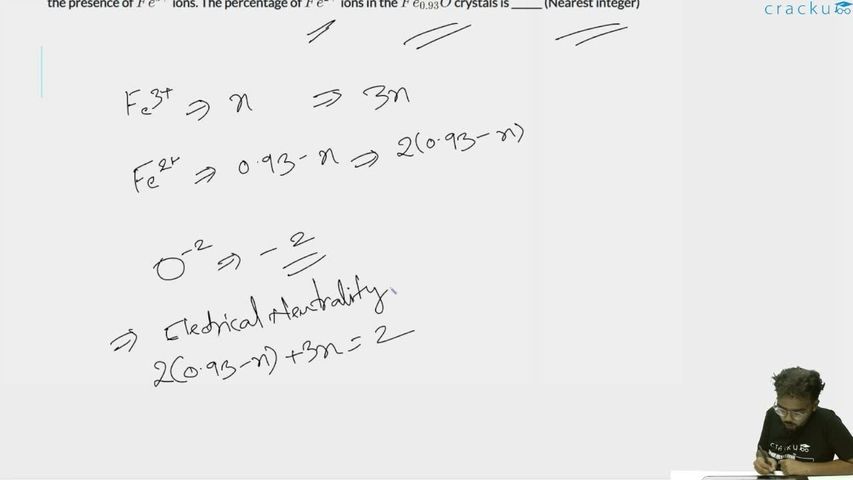
Let us assume that in the formula $$Fe_{0.93}O$$, let $$x$$ be the number of $$Fe^{3+}$$ ions and $$(0.93 - x)$$ be the number of $$Fe^{2+}$$ ions per formula unit.
Charge balance:
The total positive charge must equal the total negative charge.
Charge from $$Fe^{2+}$$: $$2(0.93 - x)$$
Charge from $$Fe^{3+}$$: $$3x$$
Charge from $$O^{2-}$$: $$-2(1) = -2$$
For electrical neutrality:
$$2(0.93 - x) + 3x = 2$$
$$1.86 - 2x + 3x = 2$$
$$1.86 + x = 2$$
$$x = 0.14$$
So, number of $$Fe^{3+}$$ ions = 0.14
Number of $$Fe^{2+}$$ ions = $$0.93 - 0.14 = 0.79$$
Percentage of $$Fe^{2+}$$ ions:
$$\% Fe^{2+} = \frac{0.79}{0.93} \times 100$$
$$= \frac{79}{93} \times 100$$
$$= 84.95\%$$
$$\approx 85\%$$
Hence, the percentage of $$Fe^{2+}$$ ions is 85 (nearest integer).
Was this solution helpful?
Click on the Email ☝️ to Watch the Video Solution
Create a FREE account and get:
_1.webp)

Educational materials for JEE preparation

Ask our AI anything

AI can make mistakes. Please verify important information.
AI can make mistakes. Please verify important information.
