
Join Our JEE Preparation Group
Prep with like-minded aspirants; Get access to free daily tests and study material.
Sign in
Please select an account to continue using cracku.in
↓ →
Join Our JEE Preparation Group
Prep with like-minded aspirants; Get access to free daily tests and study material.
Given below are two statements:
Statement I : Crystal Field Stabilization Energy (CFSE) of $$\left[Cr\left( H_{2}O \right)_{6} \right]^{2+}$$ is greater than that of $$\left[Mn\left( H_{2}O \right)_{6} \right]^{2+}$$.
Statement II: Potassium ferricyanide has a greater spin-only magnetic moment than sodium ferrocyanide.
In the light of the above statements, choose the correct answer from the options given below :
We need to evaluate two statements about Crystal Field Stabilization Energy (CFSE) and magnetic moments of coordination compounds.
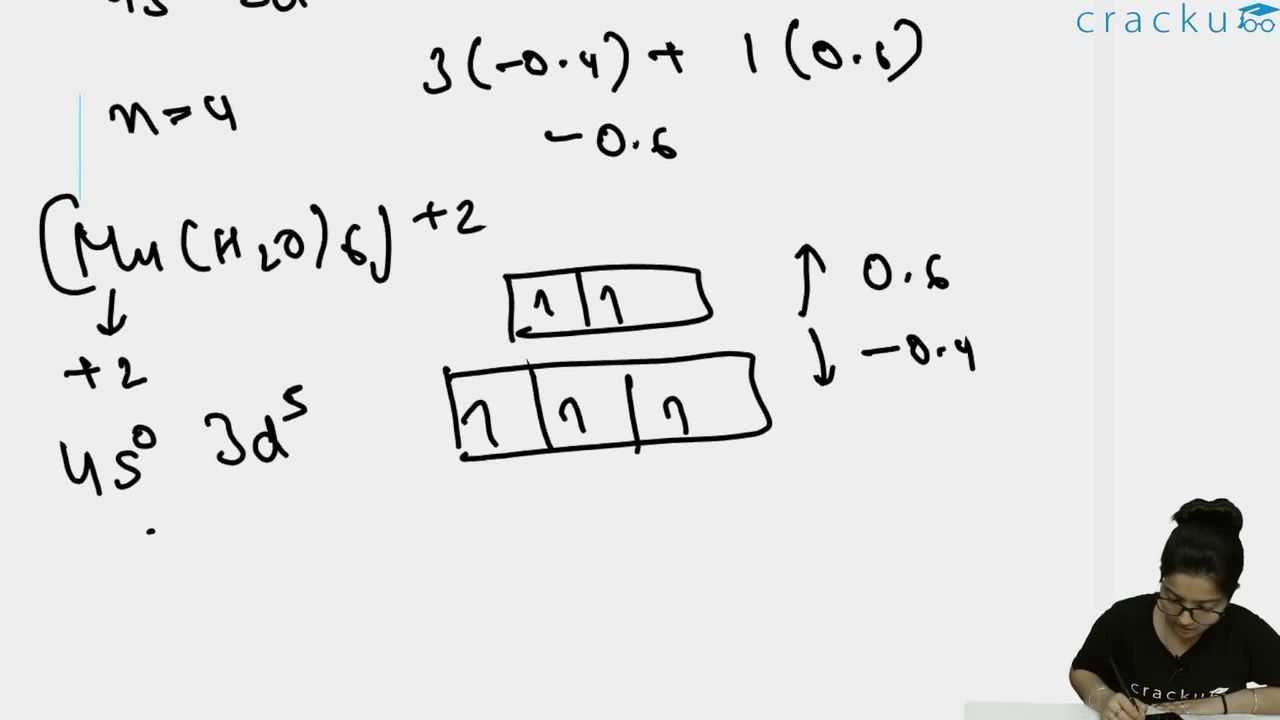
First we consider Statement I, which asserts that CFSE of $$[Cr(H_2O)_6]^{2+}$$ is greater than that of $$[Mn(H_2O)_6]^{2+}$$. Chromium(II) has atomic number 24 and electronic configuration $$[Ar]3d^4$$, making $$Cr^{2+}$$ a $$d^4$$ ion, while manganese(II) has atomic number 25 and electronic configuration $$[Ar]3d^5$$, so $$Mn^{2+}$$ is a $$d^5$$ ion.
Since $$H_2O$$ is a weak field ligand, both complexes are high‐spin octahedral. The $$d^4$$ configuration of $$Cr^{2+}$$ gives $$t_{2g}^3 e_g^1$$, and the $$d^5$$ configuration of $$Mn^{2+}$$ gives $$t_{2g}^3 e_g^2$$.
Using CFSE = $$(-0.4n_{t_{2g}} + 0.6n_{e_g})\Delta_o$$, we find for $$Cr^{2+}$$: CFSE = $$(-0.4\times3 + 0.6\times1)\Delta_o = (-1.2 + 0.6)\Delta_o = -0.6\Delta_o$$, whereas for $$Mn^{2+}$$: CFSE = $$(-0.4\times3 + 0.6\times2)\Delta_o = (-1.2 + 1.2)\Delta_o = 0$$. Because the magnitude of CFSE for $$Cr^{2+}$$ is $$0.6\Delta_o$$ and for $$Mn^{2+}$$ it is zero, CFSE of $$[Cr(H_2O)_6]^{2+}$$ is indeed greater, so Statement I is true.
Next we analyze Statement II, which compares the spin‐only magnetic moments of potassium ferricyanide and sodium ferrocyanide. Potassium ferricyanide is $$K_3[Fe(CN)_6]$$, containing $$Fe^{3+}$$ ($$d^5$$), while sodium ferrocyanide is $$Na_4[Fe(CN)_6]$$, containing $$Fe^{2+}$$ ($$d^6$$). Because $$CN^-$$ is a strong field ligand, both complexes are low‐spin octahedral. Thus $$Fe^{3+}$$ ($$d^5$$) adopts $$t_{2g}^5 e_g^0$$ with one unpaired electron, and $$Fe^{2+}$$ ($$d^6$$) adopts $$t_{2g}^6 e_g^0$$ with no unpaired electrons.
The spin‐only magnetic moment is given by $$\mu = \sqrt{n(n+2)}$$ BM, where $$n$$ is the number of unpaired electrons. For $$[Fe(CN)_6]^{3-}$$ we have $$\mu = \sqrt{1(1+2)} = \sqrt{3} \approx 1.73$$ BM, whereas for $$[Fe(CN)_6]^{4-}$$ we get $$\mu = \sqrt{0(0+2)} = 0$$ BM. Since ferricyanide has the larger moment, Statement II is true.
The correct answer is Option (3): both Statement I and Statement II are true.
Was this solution helpful?
Click on the Email ☝️ to Watch the Video Solution
Create a FREE account and get:
_1.webp)

Educational materials for JEE preparation

Ask our AI anything

AI can make mistakes. Please verify important information.
AI can make mistakes. Please verify important information.
