
Join Our JEE Preparation Group
Prep with like-minded aspirants; Get access to free daily tests and study material.
Sign in
Please select an account to continue using cracku.in
↓ →
Join Our JEE Preparation Group
Prep with like-minded aspirants; Get access to free daily tests and study material.
A fish swimming in water body when taken out from the water body is covered with a film of water of weight $$36$$ g. When it is subjected to cooking at $$100°$$C, then the internal energy for vaporization in kJ mol$$^{-1}$$ is ______ [integer]
[Assume steam to be an ideal gas. Given $$\Delta_{vap}H^\circ$$ for water at $$373$$ K and $$1$$ bar is $$41.1$$ kJ mol$$^{-1}$$ : $$R = 8.31$$ J K$$^{-1}$$ mol$$^{-1}$$]
Correct Answer: 38
We need to find the internal energy of vaporization of water at 100°C.
A water film of mass 36 g is at 100°C, which corresponds to 373 K.
The standard enthalpy of vaporization is given as $$\Delta_{vap}H^\circ = 41.1$$ kJ mol$$^{-1}$$, and the gas constant is $$R = 8.31$$ J K$$^{-1}$$ mol$$^{-1}$$.
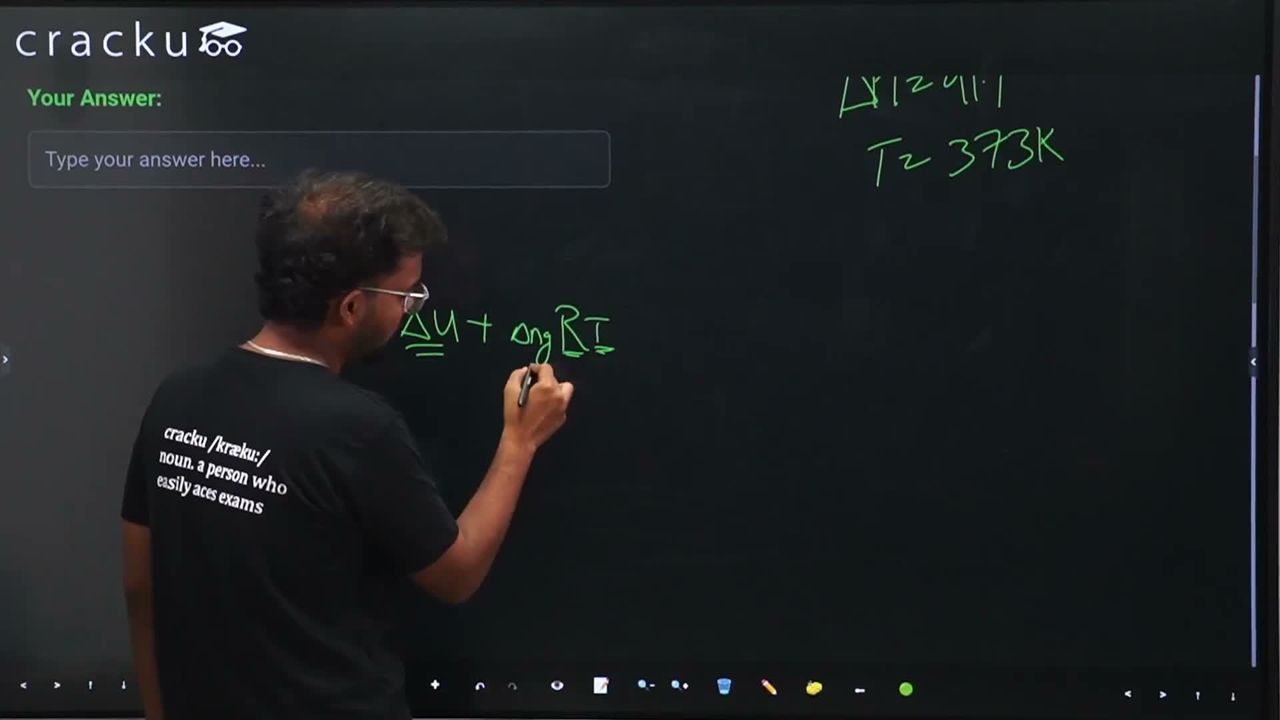
For the vaporization process $$H_2O(l) \rightarrow H_2O(g)$$, the relationship between enthalpy change and internal energy change is
$$\Delta H = \Delta U + \Delta n_g RT$$
where $$\Delta n_g$$ is the change in moles of gas, equal to 1.
Rearranging to solve for the change in internal energy gives
$$\Delta U = \Delta H - \Delta n_g RT$$
Substituting the known values:
$$\Delta U = 41.1 - (1)(8.31 \times 10^{-3})(373)$$
$$\Delta U = 41.1 - 3.0996$$
$$\Delta U = 38.0$$ kJ mol$$^{-1}$$
Thus, the internal energy of vaporization of water at 100°C is approximately 38.0 kJ mol$$^{-1}$$.
Although the mass of water (36 g = 2 mol) is provided, the question asks for the molar internal energy, so the result is expressed per mole.
Was this solution helpful?
Click on the Email ☝️ to Watch the Video Solution
Create a FREE account and get:
_1.webp)

Educational materials for JEE preparation

Ask our AI anything

AI can make mistakes. Please verify important information.
AI can make mistakes. Please verify important information.
