
Join Our JEE Preparation Group
Prep with like-minded aspirants; Get access to free daily tests and study material.
Sign in
Please select an account to continue using cracku.in
↓ →
Join Our JEE Preparation Group
Prep with like-minded aspirants; Get access to free daily tests and study material.
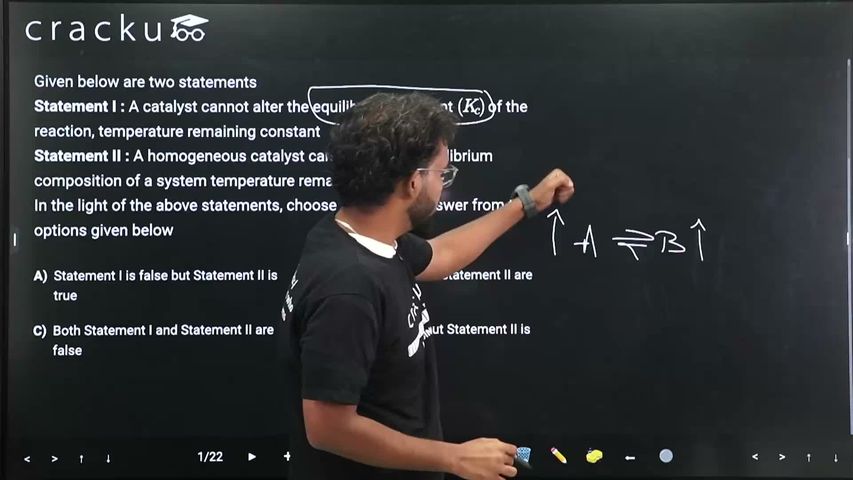
Given below are two statements
Statement I : A catalyst cannot alter the equilibrium constant $$(K_c)$$ of the reaction, temperature remaining constant
Statement II : A homogeneous catalyst can change the equilibrium composition of a system temperature remaining constant
In the light of the above statements, choose the correct answer from the options given below
We need to evaluate two statements about catalysts and chemical equilibrium.
Statement I: A catalyst cannot alter the equilibrium constant $$(K_c)$$ of the reaction, temperature remaining constant.
A catalyst works by providing an alternative reaction pathway with lower activation energy. It speeds up both the forward and reverse reactions equally.
The equilibrium constant $$K_c$$ depends only on the temperature (through the relation $$\Delta G° = -RT \ln K$$). Since a catalyst does not change the Gibbs free energy of the reaction, it cannot change $$K_c$$ at constant temperature.
Therefore, Statement I is true.
Statement II: A homogeneous catalyst can change the equilibrium composition of a system, temperature remaining constant.
Since a catalyst speeds up both the forward and reverse reactions equally, it does not shift the position of equilibrium. The equilibrium concentrations of reactants and products remain the same whether or not a catalyst is present.
A catalyst only helps the system reach equilibrium faster, but it does not alter what the equilibrium composition is.
Note: This applies to both homogeneous and heterogeneous catalysts. Neither type can change the equilibrium composition at constant temperature.
Therefore, Statement II is false.
Statement I is true and Statement II is false.
Hence, the correct answer is Option D.
Was this solution helpful?
Click on the Email ☝️ to Watch the Video Solution
Create a FREE account and get:
_1.webp)

Educational materials for JEE preparation

Ask our AI anything

AI can make mistakes. Please verify important information.
AI can make mistakes. Please verify important information.


