
Join Our JEE Preparation Group
Prep with like-minded aspirants; Get access to free daily tests and study material.
Sign in
Please select an account to continue using cracku.in
↓ →
Join Our JEE Preparation Group
Prep with like-minded aspirants; Get access to free daily tests and study material.
Which of the following statement(s) is/are true?
$$\textbf{A.}$$ If two orbitals have the same value of $$(n + l)$$, the orbital with lower value of $$n$$ will have lower energy.
$$\textbf{B.}$$ Energies of the orbitals in the same subshell increase with increase in atomic number.
$$\textbf{C.}$$ The size of $$2p_x$$ orbital is less than the size of $$3p_x$$ orbital.
$$\textbf{D.}$$ Among $$5f$$, $$6s$$, $$4d$$, $$5p$$ and $$5d$$ orbitals, none of the orbitals have 2 radial nodes.
Choose the correct answer from the options given below:
Statement A
According to the $$(n+l)$$ rule:
Example:
Since $$3p$$ has lower n, it has lower energy.
Statement A is true.
Statement B
For orbitals belonging to the same subshell (same $$n$$ and $$l$$), energy does not simply increase with atomic number. Only in hydrogen-like atoms, orbitals of same shell are degenerate (have same energy level), and in multi-electron atoms the trend is not stated this way.
Statement B is false.
Statement C
Size of orbitals generally increases with principal quantum number $$n$$.
Thus:
$$size(2p_x)<size(3p_x)$$
Statement C is true.
Statement D
Number of radial nodes:
Radial nodes=$$n−l−1$$
Calculate:
So $$5d$$ has 2 radial nodes.
Therefore the statement “none have 2 radial nodes” is false.
Statement D is False
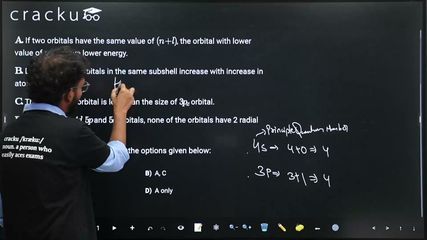
Click on the Email ☝️ to Watch the Video Solution
Create a FREE account and get:
_1.webp)

Educational materials for JEE preparation

Ask our AI anything

AI can make mistakes. Please verify important information.
AI can make mistakes. Please verify important information.


