
Join Our JEE Preparation Group
Prep with like-minded aspirants; Get access to free daily tests and study material.
Sign in
Please select an account to continue using cracku.in
↓ →
Join Our JEE Preparation Group
Prep with like-minded aspirants; Get access to free daily tests and study material.
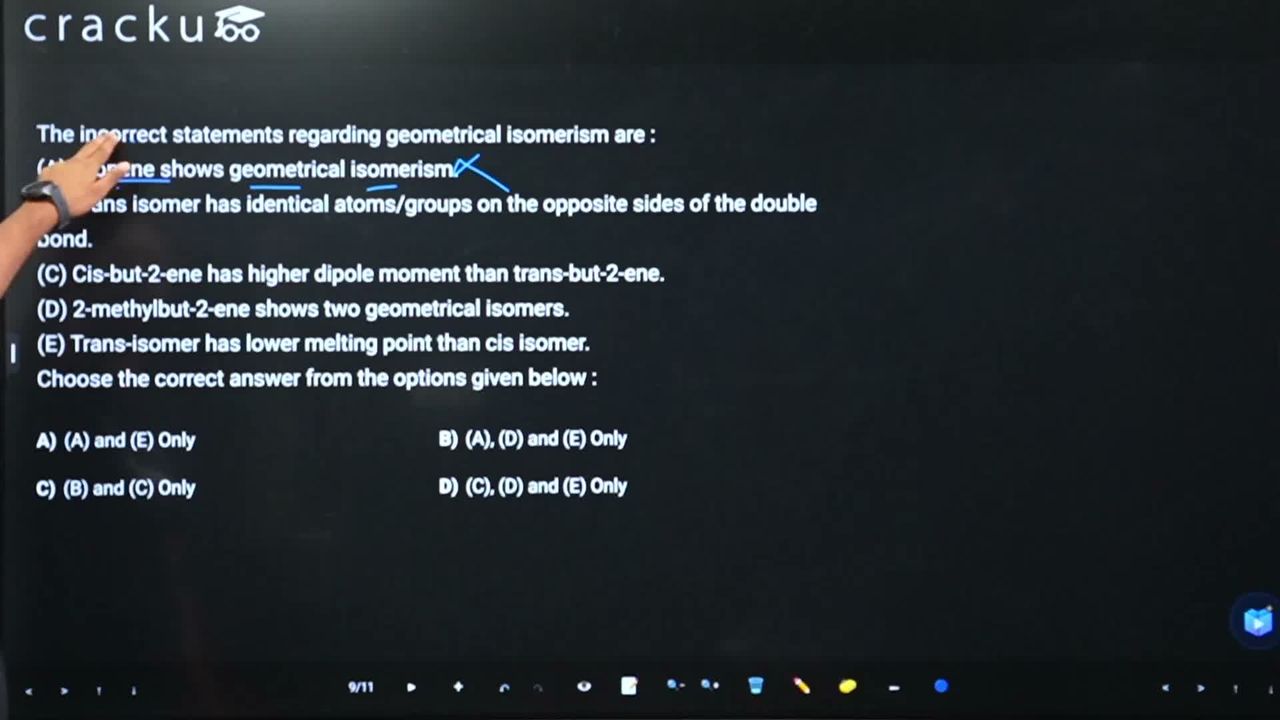
The incorrect statements regarding geometrical isomerism are :
(A) Propene shows geometrical isomerism.
(B) Trans isomer has identical atoms/groups on the opposite sides of the double bond.
(C) Cis-but-2-ene has higher dipole moment than trans-but-2-ene.
(D) 2-methylbut-2-ene shows two geometrical isomers.
(E) Trans-isomer has lower melting point than cis isomer.
Choose the correct answer from the options given below :
We need to identify the incorrect statements regarding geometrical isomerism.
(A) Propene shows geometrical isomerism.
Propene is $$CH_3-CH=CH_2$$. One carbon of the double bond has two identical groups (two H atoms). For geometrical isomerism, each carbon of the double bond must have two different substituents. Since one carbon has 2 H atoms, propene does NOT show geometrical isomerism. Statement (A) is INCORRECT.
(B) Trans isomer has identical atoms/groups on the opposite sides of the double bond.
By definition, trans isomers have identical groups on opposite sides of the double bond. This is CORRECT.
(C) Cis-but-2-ene has higher dipole moment than trans-but-2-ene.
In cis-but-2-ene, the two methyl groups are on the same side, so the bond dipoles add up, giving a non-zero dipole moment. In trans-but-2-ene, the methyl groups are on opposite sides, and the dipoles cancel out, giving zero (or nearly zero) dipole moment. So cis has a higher dipole moment. This is CORRECT.
(D) 2-methylbut-2-ene shows two geometrical isomers.
2-methylbut-2-ene is $$CH_3-C(CH_3)=CH-CH_3$$. The carbon bearing the double bond at position 2 has two methyl groups (identical substituents). Since one carbon of the double bond has two identical groups, it cannot show geometrical isomerism. Statement (D) is INCORRECT.
(E) Trans-isomer has lower melting point than cis isomer.
Generally, trans isomers have higher melting points than cis isomers because they are more symmetrical and pack better in the crystal lattice. So the statement that trans has lower melting point is INCORRECT.
The incorrect statements are (A), (D), and (E).
The correct answer is Option 2: (A), (D) and (E) Only.
Was this solution helpful?
Click on the Email ☝️ to Watch the Video Solution
Create a FREE account and get:
_1.webp)

Educational materials for JEE preparation

Ask our AI anything

AI can make mistakes. Please verify important information.
AI can make mistakes. Please verify important information.
