
Join Our JEE Preparation Group
Prep with like-minded aspirants; Get access to free daily tests and study material.
Sign in
Please select an account to continue using cracku.in
↓ →
Join Our JEE Preparation Group
Prep with like-minded aspirants; Get access to free daily tests and study material.
Let $$z = x + iy$$ be a non-zero complex number such that $$z^2 = i|z|^2$$, where $$i = \sqrt{-1}$$, then $$z$$ lies on the:
We are given a non-zero complex number $$z = x + iy$$ that satisfies the equation $$z^2 = i\,|z|^2$$, where $$i^2=-1$$.
First we expand $$z^2$$. Using the algebraic identity $$(a+b)^2 = a^2 + 2ab + b^2$$ with $$a = x$$ and $$b = iy$$, we obtain
$$z^2 = (x + iy)^2 = x^2 + 2x(iy) + (iy)^2.$$
Because $$(iy)^2 = i^2 y^2 = -y^2,$$ we have
$$z^2 = x^2 + 2ixy - y^2 = (x^2 - y^2) + 2ixy.$$
Next we write the modulus squared of $$z$$. By definition,
$$|z|^2 = x^2 + y^2.$$
The given equation is $$z^2 = i\,|z|^2,$$ so substituting the expressions we have found, we get
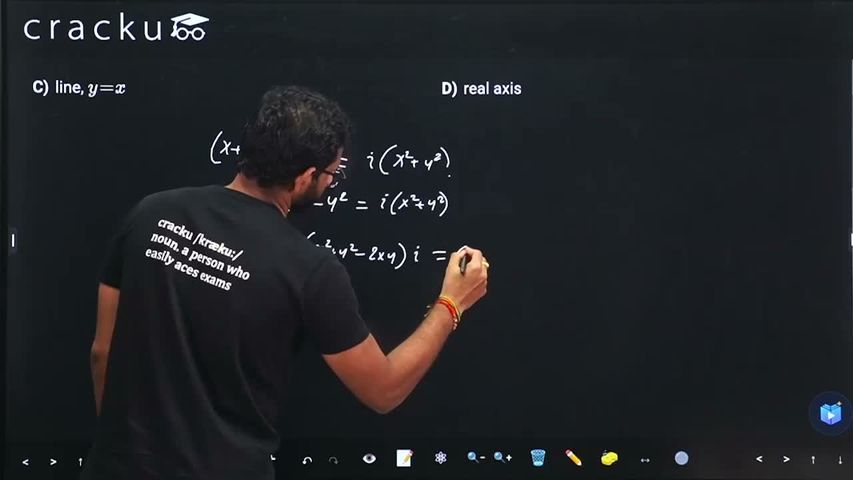
$$(x^2 - y^2) + 2ixy = i\,(x^2 + y^2).$$
We now equate the real and imaginary parts of both sides of this complex equality.
• Real parts: $$x^2 - y^2 = 0.$$
• Imaginary parts: $$2xy = x^2 + y^2.$$
From the real-part equation $$x^2 - y^2 = 0$$ we get
$$x^2 = y^2 \quad\Longrightarrow\quad y = \pm x.$$
We must check each possibility in the imaginary-part equation $$2xy = x^2 + y^2.$$ Substituting $$y = x$$, we obtain
$$2x\,(x) = x^2 + x^2 \;\Longrightarrow\; 2x^2 = 2x^2,$$
which is always true for any $$x$$. Because the problem states that $$z$$ is non-zero, we exclude the single point $$x=0$$, but every other point with $$y = x$$ satisfies the equation.
Next we substitute $$y = -x$$:
$$2x(-x) = x^2 + (-x)^2 \;\Longrightarrow\; -2x^2 = 2x^2 \;\Longrightarrow\; 4x^2 = 0.$$
This forces $$x = 0$$, which gives $$z = 0$$—contradicting the condition that $$z$$ is non-zero. Hence the choice $$y = -x$$ is rejected.
Therefore all admissible points lie on the straight line $$y = x$$ (except the origin, which is excluded). No other axis or line satisfies the given condition.
Hence, the correct answer is Option C.
Was this solution helpful?
Click on the Email ☝️ to Watch the Video Solution
Create a FREE account and get:
_1.webp)

Educational materials for JEE preparation

Ask our AI anything

AI can make mistakes. Please verify important information.
AI can make mistakes. Please verify important information.


