
Join Our JEE Preparation Group
Prep with like-minded aspirants; Get access to free daily tests and study material.
Sign in
Please select an account to continue using cracku.in
↓ →
Join Our JEE Preparation Group
Prep with like-minded aspirants; Get access to free daily tests and study material.
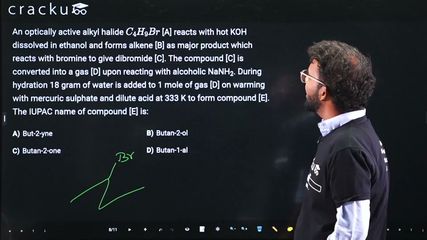
An optically active alkyl halide $$C_4H_9Br$$ [A] reacts with hot KOH dissolved in ethanol and forms alkene [B] as major product which reacts with bromine to give dibromide [C]. The compound [C] is converted into a gas [D] upon reacting with alcoholic NaNH$$_2$$. During hydration 18 gram of water is added to 1 mole of gas [D] on warming with mercuric sulphate and dilute acid at 333 K to form compound [E]. The IUPAC name of compound [E] is:
The alkyl halide [A] has formula $$C_4H_9Br$$ and is given to be optically active.
For a compound with four carbon atoms to show optical activity it must possess a chiral centre.
The only $$C_4H_9Br$$ isomer that contains such a centre is $$CH_3-CHBr-CH_2-CH_3$$, i.e. $$2$$-bromobutane.
Therefore, $$[A] =$$ 2-bromobutane.
Hot ethanolic $$KOH$$ carries out $$\beta$$-elimination (dehydrohalogenation). Eliminating $$HBr$$ from 2-bromobutane gives the more substituted alkene as the major product:
$$[A] \xrightarrow[\text{EtOH}]{\text{hot }KOH} \; CH_3-CH=CH-CH_3$$
Thus $$[B] =$$ but-2-ene (mixture of $$E$$ and $$Z$$ forms).
Adding bromine across the double bond gives a vicinal dibromide:
$$[B] + Br_2 \rightarrow CH_3-CHBr-CHBr-CH_3$$
Hence $$[C] =$$ 2,3-dibromobutane (meso + racemic mixture).
Alcoholic $$NaNH_2$$ is a very strong base; with a vic-dibromide it removes two molecules of $$HBr$$ to form an alkyne:
$$[C] \xrightarrow[\text{alc.}]{NaNH_2} CH_3-C \equiv C-CH_3$$
Therefore $$[D] =$$ but-2-yne, a gaseous alkyne (molar mass $$=54$$ g mol$$^{-1}$$). During this step nothing else is added or lost other than $$2HBr$$, so the formula of $$[D]$$ is $$C_4H_6$$.
The statement “18 g of water is added to 1 mol of gas $$[D]$$” confirms that exactly one mole of $$H_2O$$ (18 g) adds to each mole of alkyne, matching hydration of a single triple bond.
Markovnikov hydration of an internal alkyne is carried out with dilute acid and mercuric sulphate catalyst at 333 K. First an enol forms, which then tautomerises to a ketone:
$$CH_3-C \equiv C-CH_3 \xrightarrow[\text{HgSO}_4]{H_2O/H^+, \;333\,\text{K}} CH_3-CO-CH_2-CH_3$$
The product $$[E]$$ is $$CH_3-CO-CH_2-CH_3$$, whose IUPAC name is butan-2-one.
Thus the correct option is Option C: Butan-2-one.
Was this solution helpful?
Click on the Email ☝️ to Watch the Video Solution
Create a FREE account and get:
_1.webp)

Educational materials for JEE preparation

Ask our AI anything

AI can make mistakes. Please verify important information.
AI can make mistakes. Please verify important information.


