
Join Our JEE Preparation Group
Prep with like-minded aspirants; Get access to free daily tests and study material.
Sign in
Please select an account to continue using cracku.in
↓ →
Join Our JEE Preparation Group
Prep with like-minded aspirants; Get access to free daily tests and study material.
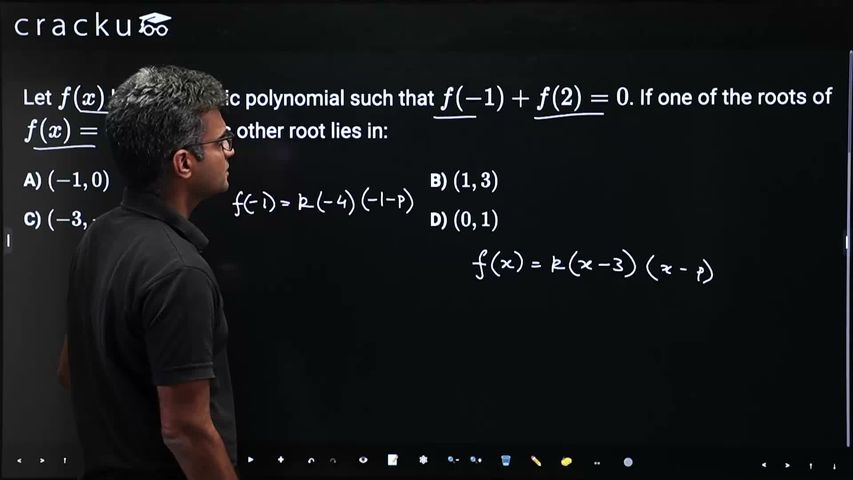
Let $$f(x)$$ be a quadratic polynomial such that $$f(-1) + f(2) = 0$$. If one of the roots of $$f(x) = 0$$ is 3, then its other root lies in:
We are told that $$f(x)$$ is a quadratic polynomial, that one of its roots is $$3$$, and that the values of the polynomial at $$x=-1$$ and $$x=2$$ satisfy $$f(-1)+f(2)=0$$. Our aim is to find the interval in which the other root lies.
Because $$f(x)$$ is quadratic and one root is already known, we can write it in the standard “root-factor” form. A quadratic having real roots $$\alpha$$ and $$\beta$$ can always be expressed as
$$f(x)=k\,(x-\alpha)(x-\beta),$$
where $$k\neq 0$$ is a non-zero constant. Here, one root is given as $$3$$, so we set $$\alpha = 3$$ and denote the unknown second root by $$\beta$$. Thus,
$$f(x)=k\,(x-3)(x-\beta).$$
Next, we evaluate $$f(x)$$ at the two specified points.
First at $$x=-1$$:
$$\begin{aligned} f(-1) &= k\,((-1)-3)\bigl((-1)-\beta\bigr) \\ &= k\,(-4)\,(-1-\beta) \\ &= k\,\bigl(4(1+\beta)\bigr) \\ &= 4k(1+\beta). \end{aligned}$$
Now at $$x=2$$:
$$\begin{aligned} f(2) &= k\,(2-3)(2-\beta) \\ &= k\,(-1)\,(2-\beta) \\ &= -k(2-\beta). \end{aligned}$$
According to the condition in the problem, the sum of these two values is zero:
$$f(-1)+f(2)=0.$$ Substituting the expressions we just computed, we obtain
$$4k(1+\beta)\;+\;\bigl[-k(2-\beta)\bigr]=0.$$
We can factor out the common non-zero constant $$k$$ (since $$k\neq 0$$ for a non-trivial quadratic):
$$k\Bigl[\,4(1+\beta)-(2-\beta)\Bigr]=0.$$
Because $$k\neq 0,$$ the bracketed expression must itself be zero:
$$4(1+\beta)-(2-\beta)=0.$$
Expanding and combining like terms, we get
$$\begin{aligned} 4+4\beta-2+\beta &= 0 \\ (4-2)+ (4\beta+\beta) &= 0 \\ 2 + 5\beta &= 0. \end{aligned}$$
Solving for $$\beta,$$
$$5\beta = -2 \quad\Longrightarrow\quad \beta = -\dfrac{2}{5} = -0.4.$$
Thus the second root is $$\beta=-0.4$$. We now compare this value with the intervals given in the options:
Only Option A encloses the value $$-0.4$$.
Hence, the correct answer is Option A.
Was this solution helpful?
Click on the Email ☝️ to Watch the Video Solution
Create a FREE account and get:
_1.webp)

Educational materials for JEE preparation

Ask our AI anything

AI can make mistakes. Please verify important information.
AI can make mistakes. Please verify important information.


