
Join Our JEE Preparation Group
Prep with like-minded aspirants; Get access to free daily tests and study material.
Sign in
Please select an account to continue using cracku.in
↓ →
Join Our JEE Preparation Group
Prep with like-minded aspirants; Get access to free daily tests and study material.
If the uncertainty in velocity and position of a minute particle in space are, $$2.4 \times 10^{-26}$$ (ms$$^{-1}$$) and $$10^{-7}$$ (m) respectively. The mass of the particle in g is ______ (Nearest integer)
(Given : $$h = 6.626 \times 10^{-34}$$ Js)
Correct Answer: 22
We use the Heisenberg uncertainty principle to find the mass of the particle.
The Heisenberg uncertainty principle states:
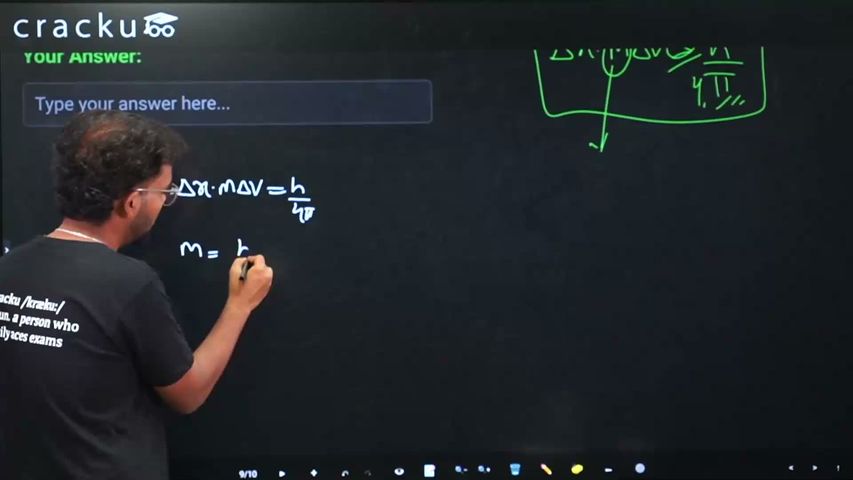
$$\Delta x \cdot m \cdot \Delta v \geq \frac{h}{4\pi}$$
where $$\Delta x$$ is the uncertainty in position, $$\Delta v$$ is the uncertainty in velocity, $$m$$ is the mass, and $$h$$ is Planck's constant. The known values are $$\Delta v = 2.4 \times 10^{-26}$$ m/s, $$\Delta x = 10^{-7}$$ m, and $$h = 6.626 \times 10^{-34}$$ Js.
Rearranging the formula for mass and taking equality for minimum uncertainty gives:
$$m = \frac{h}{4\pi \cdot \Delta x \cdot \Delta v}$$
Substituting the given values, we have:
$$m = \frac{6.626 \times 10^{-34}}{4 \times 3.14 \times 10^{-7} \times 2.4 \times 10^{-26}}$$
Calculating the denominator step by step, note that $$4 \times 3.14 = 12.56$$ and $$12.56 \times 2.4 = 30.144$$. The combined power of ten in the denominator is $$10^{-7} \times 10^{-26} = 10^{-33}$$, so the denominator becomes $$30.144 \times 10^{-33}$$.
Thus,
$$m = \frac{6.626 \times 10^{-34}}{30.144 \times 10^{-33}}$$
$$m = \frac{6.626}{30.144} \times 10^{-34+33}$$
$$m = 0.2198 \times 10^{-1}$$ kg, which simplifies to $$m = 0.02198$$ kg.
Converting this mass into grams yields $$m = 0.02198 \times 1000 = 21.98$$ g, and rounding to the nearest integer gives $$m \approx 22$$ g.
Hence, the mass of the particle is 22 g.
Was this solution helpful?
Click on the Email ☝️ to Watch the Video Solution
Create a FREE account and get:
_1.webp)

Educational materials for JEE preparation

Ask our AI anything

AI can make mistakes. Please verify important information.
AI can make mistakes. Please verify important information.
