
Join Our JEE Preparation Group
Prep with like-minded aspirants; Get access to free daily tests and study material.
Sign in
Please select an account to continue using cracku.in
↓ →
Join Our JEE Preparation Group
Prep with like-minded aspirants; Get access to free daily tests and study material.
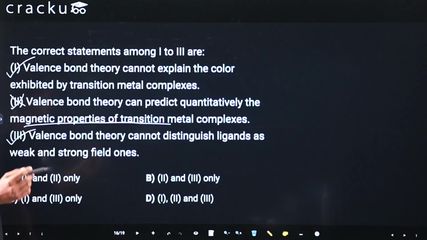
The correct statements among I to III are:
(I) Valence bond theory cannot explain the color exhibited by transition metal complexes.
(II) Valence bond theory can predict quantitatively the magnetic properties of transition metal complexes.
(III) Valence bond theory cannot distinguish ligands as weak and strong field ones.
We need to determine which of the given statements about Valence Bond Theory (VBT) are correct.
Statement (I): "Valence bond theory cannot explain the color exhibited by transition metal complexes."
This statement is correct. VBT deals with the overlap of atomic orbitals to form bonds and describes the geometry and magnetic behaviour of complexes. However, it does not address the electronic transitions responsible for the absorption of light and the resulting colour of complexes. The explanation of colour requires Crystal Field Theory (CFT) or Ligand Field Theory, which consider the splitting of d-orbitals and the energy gap $$\Delta$$.
Statement (II): "Valence bond theory can predict quantitatively the magnetic properties of transition metal complexes."
This statement is incorrect. VBT can only predict whether a complex is paramagnetic or diamagnetic (a qualitative prediction) based on the presence of unpaired electrons. It cannot provide quantitative predictions of magnetic moments because it does not account for orbital contributions to magnetism or explain why certain ligands cause electron pairing while others do not. The magnetic moment values predicted by VBT often do not match experimental observations quantitatively.
Statement (III): "Valence bond theory cannot distinguish ligands as weak and strong field ones."
This statement is correct. VBT does not provide a framework to classify ligands into weak field and strong field categories. The distinction between weak field ligands (such as $$F^-$$, $$Cl^-$$) and strong field ligands (such as $$CN^-$$, $$CO$$) is a feature of Crystal Field Theory, which uses the spectrochemical series based on the magnitude of crystal field splitting $$\Delta$$.
Therefore, the correct statements are (I) and (III) only.
The correct answer is Option C: (I) and (III) only.
Was this solution helpful?
Click on the Email ☝️ to Watch the Video Solution
Create a FREE account and get:
_1.webp)

Educational materials for JEE preparation

Ask our AI anything

AI can make mistakes. Please verify important information.
AI can make mistakes. Please verify important information.


