
Join Our JEE Preparation Group
Prep with like-minded aspirants; Get access to free daily tests and study material.
Sign in
Please select an account to continue using cracku.in
↓ →
Join Our JEE Preparation Group
Prep with like-minded aspirants; Get access to free daily tests and study material.
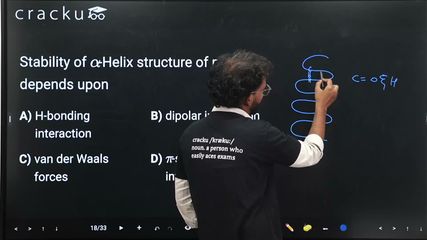
Stability of $$\alpha$$-Helix structure of proteins depends upon
The question asks to identify the interaction responsible for the stability of the $$\alpha$$-helix structure of proteins. The $$\alpha$$-helix is a common secondary structure in which the polypeptide chain coils in a right-handed helical fashion. This structure is stabilized by intramolecular hydrogen bonds formed between the $$C=O$$ group (hydrogen bond acceptor) of one amino acid residue and the $$N-H$$ group (hydrogen bond donor) of the residue four positions ahead in the sequence. Specifically, hydrogen bonding occurs between the $$C=O$$ of the $$i^{th}$$ residue and the $$N-H$$ of the $$(i+4)^{th}$$ residue, with these bonds running roughly parallel to the helix axis and maintaining the coiled structure.
Other interactions such as dipolar interactions are weaker and do not primarily stabilize the $$\alpha$$-helix, van der Waals forces are too weak to maintain the helical backbone, and $$\pi$$-stacking interactions involve aromatic rings and are unrelated to backbone stabilization.
Therefore, the correct answer is Option A: H-bonding interaction.
Was this solution helpful?
Click on the Email ☝️ to Watch the Video Solution
Create a FREE account and get:
_1.webp)

Educational materials for JEE preparation

Ask our AI anything

AI can make mistakes. Please verify important information.
AI can make mistakes. Please verify important information.
