
Join Our JEE Preparation Group
Prep with like-minded aspirants; Get access to free daily tests and study material.
Sign in
Please select an account to continue using cracku.in
↓ →
Join Our JEE Preparation Group
Prep with like-minded aspirants; Get access to free daily tests and study material.
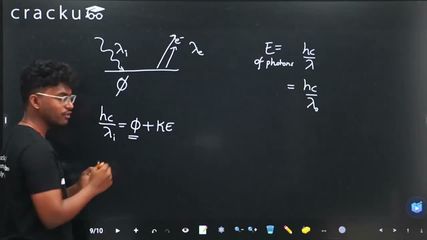
A photo-emissive substance is illuminated with a radiation of wavelength $$\lambda_i$$ so that it releases electrons with de-Broglie wavelength $$\lambda_e$$. The longest wavelength of radiation that can emit photoelectron is $$\lambda_0$$. Expression for de-Broglie wavelength is given by : (m : mass of the electron, h : Planck's constant and c : speed of light)
For a photo-electric surface, Einstein’s equation relates the energy of the incident photon, the work function of the metal and the maximum kinetic energy of the emitted electron:
$$\frac{hc}{\lambda_i}= \frac{hc}{\lambda_0}+K_{\max} \qquad -(1)$$
Here
$$\lambda_i$$ = wavelength of the incident radiation,
$$\lambda_0$$ = threshold (longest) wavelength that can just eject an electron,
$$K_{\max}$$ = maximum kinetic energy of the emitted electron.
Re-arranging $$-(1)$$ gives the kinetic energy:
$$K_{\max}=hc\!\left(\frac{1}{\lambda_i}-\frac{1}{\lambda_0}\right) \qquad -(2)$$
The de-Broglie wavelength $$\lambda_e$$ of the emitted electron is related to its momentum $$p$$ by
$$\lambda_e=\frac{h}{p} \qquad -(3)$$
Momentum is obtained from kinetic energy using $$p=\sqrt{2mK_{\max}}$$, so with $$-(2)$$
$$p=\sqrt{\,2m\,hc\left(\frac{1}{\lambda_i}-\frac{1}{\lambda_0}\right)} \qquad -(4)$$
Substituting $$-(4)$$ in the de-Broglie relation $$-(3)$$:
$$\lambda_e=\frac{h}{\sqrt{\,2m\,hc\left(\frac{1}{\lambda_i}-\frac{1}{\lambda_0}\right)}}$$
Comparing with the given options, this expression matches Option A.
Hence, the required expression is
$$\displaystyle \lambda_e=\frac{h}{\sqrt{2mhc\left(\frac{1}{\lambda_i}-\frac{1}{\lambda_0}\right)}}$$
and the correct choice is Option A.
Was this solution helpful?
Click on the Email ☝️ to Watch the Video Solution
Create a FREE account and get:
_1.webp)

Educational materials for JEE preparation

Ask our AI anything

AI can make mistakes. Please verify important information.
AI can make mistakes. Please verify important information.
