
Join Our JEE Preparation Group
Prep with like-minded aspirants; Get access to free daily tests and study material.
Sign in
Please select an account to continue using cracku.in
↓ →
Join Our JEE Preparation Group
Prep with like-minded aspirants; Get access to free daily tests and study material.
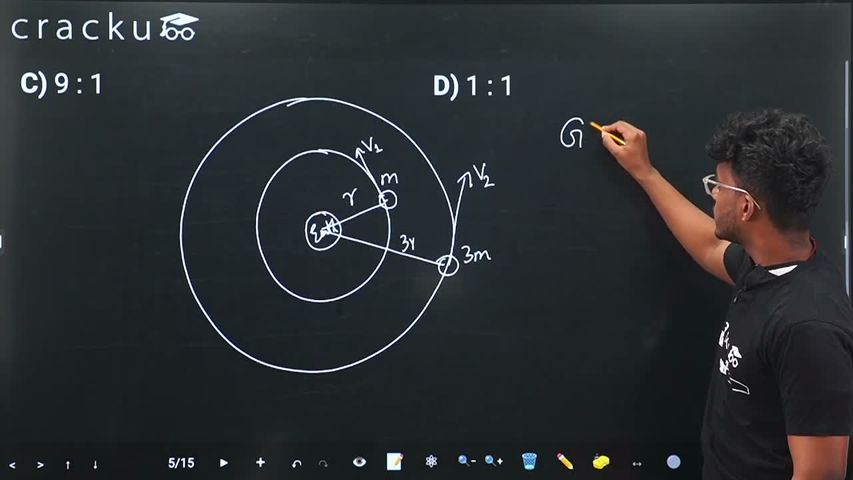
Two satellites of masses m and 3m revolve around the earth in circular orbits of radii r & 3r respectively. The ratio of orbital speeds of the satellites respectively is
Two satellites of masses $$m$$ and $$3m$$ revolve in circular orbits of radii $$r$$ and $$3r$$ respectively. We need to find the ratio of their orbital speeds.
First, derive the orbital speed formula.
For a satellite in circular orbit, the gravitational force provides the centripetal force:
$$ \frac{GMm_s}{r_s^2} = \frac{m_s v^2}{r_s} $$
where $$M$$ is Earth's mass, $$m_s$$ is the satellite mass, and $$r_s$$ is the orbital radius. Notice that the satellite mass $$m_s$$ cancels:
$$ v = \sqrt{\frac{GM}{r_s}} $$
This is a crucial result: orbital speed depends only on the orbital radius, not on the satellite's mass.
Next, calculate the ratio of orbital speeds.
For satellite 1 (orbit radius $$r$$): $$v_1 = \sqrt{\frac{GM}{r}}$$
For satellite 2 (orbit radius $$3r$$): $$v_2 = \sqrt{\frac{GM}{3r}}$$
$$ \frac{v_1}{v_2} = \sqrt{\frac{GM/r}{GM/3r}} = \sqrt{\frac{3r}{r}} = \sqrt{3} $$
The ratio of orbital speeds is $$\sqrt{3} : 1$$.
The correct answer is Option 1: $$\sqrt{3} : 1$$.
Click on the Email ☝️ to Watch the Video Solution
Create a FREE account and get:
_1.webp)

Educational materials for JEE preparation

Ask our AI anything

AI can make mistakes. Please verify important information.
AI can make mistakes. Please verify important information.


