
Join Our JEE Preparation Group
Prep with like-minded aspirants; Get access to free daily tests and study material.
Sign in
Please select an account to continue using cracku.in
↓ →
Join Our JEE Preparation Group
Prep with like-minded aspirants; Get access to free daily tests and study material.
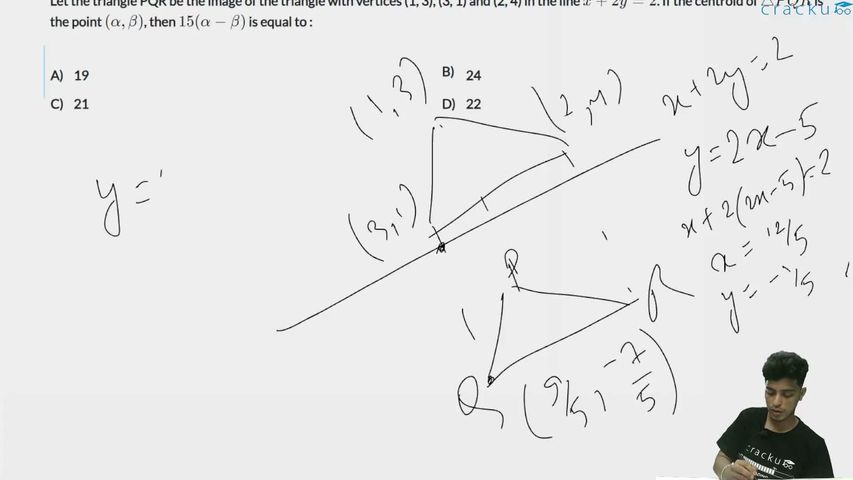
Let the triangle PQR be the image of the triangle with vertices (1, 3), (3, 1) and (2, 4) in the line $$x+2y=2$$. If the centroid of $$ \triangle PQR $$ is the point $$ (\alpha, \beta) $$, then $$ 15(\alpha - \beta) $$ is equal to :
To find the image of the triangle with vertices (1, 3), (3, 1), and (2, 4) in the line $$x + 2y = 2$$, we first rewrite the line equation as $$x + 2y - 2 = 0$$. Here, $$a = 1$$, $$b = 2$$, and $$c = -2$$.
The formula for the image $$(x_2, y_2)$$ of a point $$(x_1, y_1)$$ in the line $$ax + by + c = 0$$ is given by:
$$ \frac{x_2 - x_1}{a} = \frac{y_2 - y_1}{b} = \frac{-2(a x_1 + b y_1 + c)}{a^2 + b^2} $$
Substituting $$a = 1$$, $$b = 2$$, and $$c = -2$$:
$$ \frac{x_2 - x_1}{1} = \frac{y_2 - y_1}{2} = \frac{-2(1 \cdot x_1 + 2 \cdot y_1 - 2)}{1^2 + 2^2} = \frac{-2(x_1 + 2y_1 - 2)}{5} $$
Let the common ratio be $$k$$, so:
$$ x_2 = x_1 + k, \quad y_2 = y_1 + 2k, \quad \text{where} \quad k = \frac{-2(x_1 + 2y_1 - 2)}{5} $$
Solving for $$x_2$$ and $$y_2$$:
$$ x_2 = x_1 + \frac{-2(x_1 + 2y_1 - 2)}{5} = \frac{5x_1 - 2x_1 - 4y_1 + 4}{5} = \frac{3x_1 - 4y_1 + 4}{5} $$
$$ y_2 = y_1 + 2 \cdot \frac{-2(x_1 + 2y_1 - 2)}{5} = \frac{5y_1 - 4x_1 - 8y_1 + 8}{5} = \frac{-4x_1 - 3y_1 + 8}{5} $$
Now, find the images of each vertex:
Image of A(1, 3):
$$ x_P = \frac{3(1) - 4(3) + 4}{5} = \frac{3 - 12 + 4}{5} = \frac{-5}{5} = -1 $$
$$ y_P = \frac{-4(1) - 3(3) + 8}{5} = \frac{-4 - 9 + 8}{5} = \frac{-5}{5} = -1 $$
So, P is $$(-1, -1)$$.
Image of B(3, 1):
$$ x_Q = \frac{3(3) - 4(1) + 4}{5} = \frac{9 - 4 + 4}{5} = \frac{9}{5} $$
$$ y_Q = \frac{-4(3) - 3(1) + 8}{5} = \frac{-12 - 3 + 8}{5} = \frac{-7}{5} $$
So, Q is $$\left(\frac{9}{5}, -\frac{7}{5}\right)$$.
Image of C(2, 4):
$$ x_R = \frac{3(2) - 4(4) + 4}{5} = \frac{6 - 16 + 4}{5} = \frac{-6}{5} $$
$$ y_R = \frac{-4(2) - 3(4) + 8}{5} = \frac{-8 - 12 + 8}{5} = \frac{-12}{5} $$
So, R is $$\left(-\frac{6}{5}, -\frac{12}{5}\right)$$.
The vertices of $$\triangle PQR$$ are P$$(-1, -1)$$, Q$$\left(\frac{9}{5}, -\frac{7}{5}\right)$$, and R$$\left(-\frac{6}{5}, -\frac{12}{5}\right)$$.
The centroid $$(\alpha, \beta)$$ of a triangle with vertices $$(x_1, y_1)$$, $$(x_2, y_2)$$, $$(x_3, y_3)$$ is given by:
$$ \alpha = \frac{x_1 + x_2 + x_3}{3}, \quad \beta = \frac{y_1 + y_2 + y_3}{3} $$
Compute $$\alpha$$:
$$ \alpha = \frac{-1 + \frac{9}{5} + \left(-\frac{6}{5}\right)}{3} = \frac{-1 + \frac{9}{5} - \frac{6}{5}}{3} $$
First, simplify the numerator:
$$ -1 + \frac{9}{5} - \frac{6}{5} = -1 + \frac{3}{5} = -\frac{5}{5} + \frac{3}{5} = -\frac{2}{5} $$
Then,
$$ \alpha = \frac{-\frac{2}{5}}{3} = -\frac{2}{5} \times \frac{1}{3} = -\frac{2}{15} $$
Compute $$\beta$$:
$$ \beta = \frac{-1 + \left(-\frac{7}{5}\right) + \left(-\frac{12}{5}\right)}{3} = \frac{-1 - \frac{7}{5} - \frac{12}{5}}{3} $$
Simplify the numerator:
$$ -1 - \frac{7}{5} - \frac{12}{5} = -1 - \frac{19}{5} = -\frac{5}{5} - \frac{19}{5} = -\frac{24}{5} $$
Then,
$$ \beta = \frac{-\frac{24}{5}}{3} = -\frac{24}{5} \times \frac{1}{3} = -\frac{24}{15} = -\frac{8}{5} $$
Now compute $$\alpha - \beta$$:
$$ \alpha - \beta = -\frac{2}{15} - \left(-\frac{8}{5}\right) = -\frac{2}{15} + \frac{8}{5} $$
Convert to a common denominator of 15:
$$ \frac{8}{5} = \frac{8 \times 3}{5 \times 3} = \frac{24}{15} $$
So,
$$ \alpha - \beta = -\frac{2}{15} + \frac{24}{15} = \frac{22}{15} $$
Now compute $$15(\alpha - \beta)$$:
$$ 15(\alpha - \beta) = 15 \times \frac{22}{15} = 22 $$
Therefore, $$15(\alpha - \beta) = 22$$, which corresponds to option D.
Was this solution helpful?
Click on the Email ☝️ to Watch the Video Solution
Create a FREE account and get:
_1.webp)

Educational materials for JEE preparation

Ask our AI anything

AI can make mistakes. Please verify important information.
AI can make mistakes. Please verify important information.
