Sign in
Please select an account to continue using cracku.in
↓ →
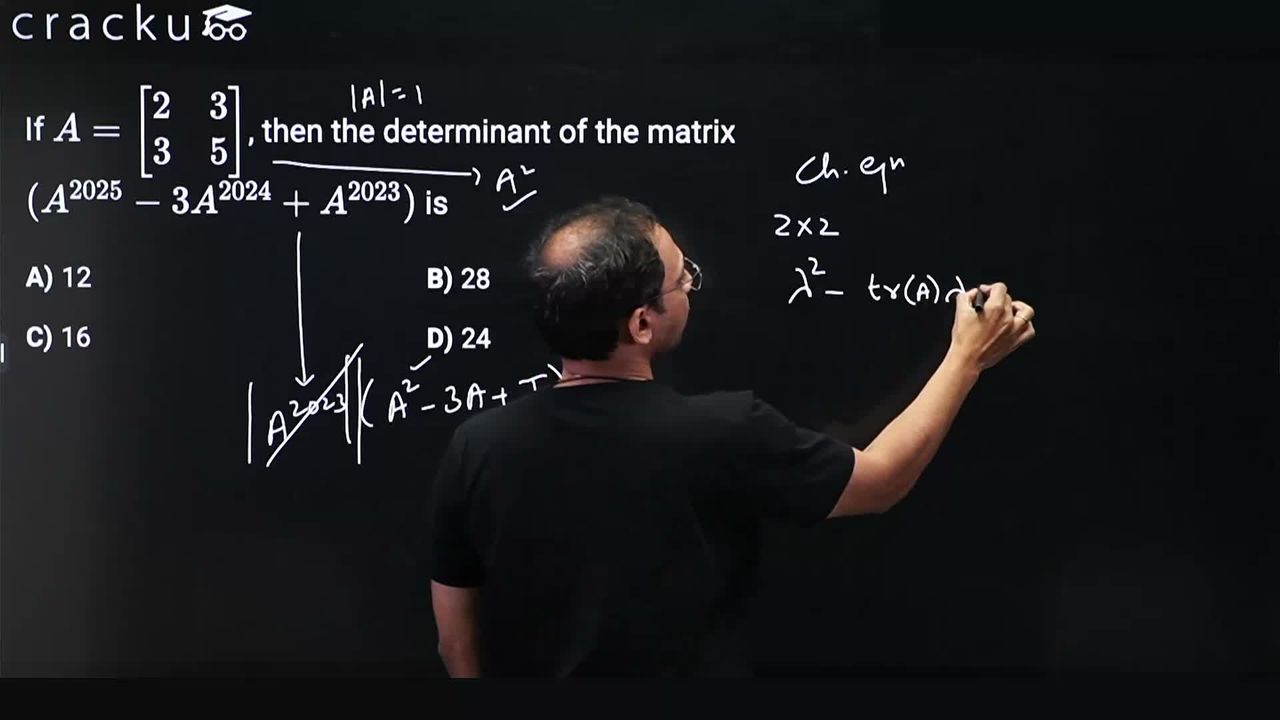
If $$A=\begin{bmatrix}2 & 3 \\3 & 5 \end{bmatrix}$$, then the determinant of the matrix $$ (A^{2025}-3A^{2024}+ A^{2023})$$ is
We are given the matrix $$A = \begin{bmatrix}2 & 3 \\ 3 & 5\end{bmatrix}$$ and we wish to find the determinant of $$M = A^{2025} \;-\; 3A^{2024}\;+\;A^{2023}\,.$$
Step 1: Factor out $$A^{2023}$$ from the expression.
We write $$M \;=\; A^{2023}\bigl(A^2 \;-\; 3A \;+\; I\bigr)\,.$$
Step 2: Use the property of determinants.
For any square matrices of the same order, $$\det(XY) = \det(X)\,\det(Y)\,. $$
Hence, $$\det(M) =\det\bigl(A^{2023}\bigr)\;\det\bigl(A^2 -3A +I\bigr)\,.\quad-(1)$$
Step 3: Compute $$\det\bigl(A^{2023}\bigr)$$.
We know $$\det(A^n) = (\det A)^n\,. $$
First compute $$\det(A) = (2)(5) - (3)(3) = 10 -9 =1\,. $$
Therefore $$\det\bigl(A^{2023}\bigr) = (\det A)^{2023} = 1^{2023} = 1\,. \quad-(2)$$
Step 4: Compute $$\det\bigl(A^2 -3A +I\bigr)$$ by using the eigenvalues of $$A$$.
Let the eigenvalues of $$A$$ be $$\lambda_1$$ and $$\lambda_2$$. They satisfy the characteristic equation $$\det\bigl(A - \lambda I\bigr)=0 \;\Longrightarrow\; \lambda^2 \;-\;7\lambda\;+\;1 = 0\,.$$ Thus the sum and product of the roots are $$\lambda_1 + \lambda_2 = 7,\quad \lambda_1\,\lambda_2 = 1\,.\quad-(3)$$
Define the polynomial $$f(\lambda) = \lambda^2 \;-\; 3\lambda \;+\;1\,.$$ Then the eigenvalues of the matrix $$A^2 -3A +I$$ are $$f(\lambda_1)$$ and $$f(\lambda_2)\,$$ so $$\det\bigl(A^2 -3A +I\bigr) = f(\lambda_1)\,f(\lambda_2)\,.\quad-(4)$$
Step 5: Compute $$f(\lambda_1)\,f(\lambda_2)$$ using symmetric sums.
We expand: $$f(\lambda_1)\,f(\lambda_2) = (\lambda_1^2 -3\lambda_1 +1)\;(\lambda_2^2 -3\lambda_2 +1)\,.$$ Expand term by term: $$ \begin{aligned} &= \lambda_1^2\lambda_2^2 \;-\;3(\lambda_1^2\lambda_2 +\lambda_1\lambda_2^2)\\ &\quad\;+\;(\lambda_1^2 + \lambda_2^2) \;+\;9\lambda_1\lambda_2\\ &\quad\;-\;3(\lambda_1 + \lambda_2) \;+\;1\,. \end{aligned} $$
Now substitute the symmetric sums from $$(3)$$:
• $$\lambda_1\lambda_2 = 1$$ $$\Longrightarrow$$ $$\lambda_1^2\lambda_2^2 =1^2=1\,. $$
• $$\lambda_1 + \lambda_2 = 7$$ $$\Longrightarrow$$
$$\lambda_1^2 + \lambda_2^2 = 49 -2 =47\,. $$
• $$\lambda_1^2\lambda_2 + \lambda_1\lambda_2^2 = 7\,. $$
Substitute these into the expansion:
$$ \begin{aligned} f(\lambda_1)\,f(\lambda_2) &= 1 \;-\;3(7) \;+\;47\\ &\quad\;+\;9(1) \;-\;3(7) \;+\;1\\ &= 1 -21 +47 +9 -21 +1\\ &= 16\,. \end{aligned} $$
Hence from $$(4)$$, $$\det\bigl(A^2 -3A +I\bigr) = 16\,. \quad-(5)$$
Step 6: Combine results using $$(1)$$, $$(2)$$ and $$(5)$$.
$$ \det(M) = \det\bigl(A^{2023}\bigr)\,\det\bigl(A^2 -3A +I\bigr) = 1 \times 16 = 16. $$
Final Answer: The determinant is $$16\,$$ (Option C).
Create a FREE account and get:
Educational materials for JEE preparation