
Join Our JEE Preparation Group
Prep with like-minded aspirants; Get access to free daily tests and study material.
Sign in
Please select an account to continue using cracku.in
↓ →
Join Our JEE Preparation Group
Prep with like-minded aspirants; Get access to free daily tests and study material.
For some $$n \ne 10,$$ let the coefficients of the 5th, 6th and 7th terms in the binomial expansion of $$(1+x)^{n+4}$$ be in A.P. Then the largest coefficient in the expansion of $$(1+x)^{n+4}$$ is:
Coefficients of 5th, 6th and 7th terms of $$(1+x)^{n+4}$$ are in arithmetic progression.
Let N = n + 4 so that the coefficient of the rth term is $$\binom{N}{r-1}$$.
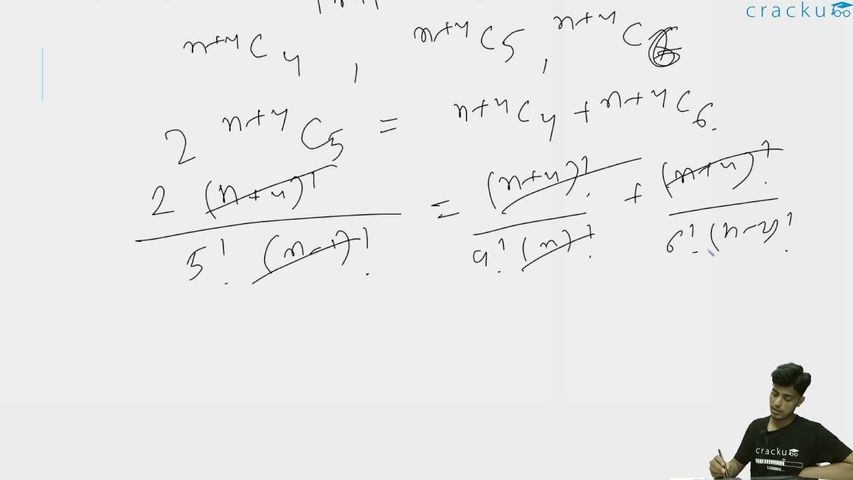
Hence the 5th term has coefficient $$\binom{N}{4}$$, the 6th term has coefficient $$\binom{N}{5}$$, and the 7th term has coefficient $$\binom{N}{6}$$.
Imposing the arithmetic progression condition yields $$2\binom{N}{5} = \binom{N}{4} + \binom{N}{6}$$.
Using the identities $$\binom{N}{5} = \frac{N-4}{5}\binom{N}{4}$$ and $$\binom{N}{6} = \frac{N-5}{6}\binom{N}{5}$$ and dividing through by $$\binom{N}{4}$$ gives $$2\frac{N-4}{5} = 1 + \frac{(N-4)(N-5)}{30}$$.
Multiplying both sides by 30 leads to $$12(N-4) = 30 + (N-4)(N-5)$$.
Setting $$m = N-4$$ transforms this into $$12m = 30 + m(m-1)$$, or $$m^2 - 13m + 30 = 0$$.
$$(m-3)(m-10) = 0$$ so that $$m = 3$$ or $$m = 10$$. Thus $$N = 7$$ or $$N = 14$$, giving $$n = 3$$ or $$n = 10$$. Excluding $$n = 10$$, we have $$n = 3$$ and hence $$N = 7$$.
In the expansion of $$(1+x)^7$$ the largest binomial coefficient is $$\binom{7}{3} = \binom{7}{4} = 35$$.
The correct answer is Option 3: 35.
Was this solution helpful?
Click on the Email ☝️ to Watch the Video Solution
Create a FREE account and get:
_1.webp)

Educational materials for JEE preparation

Ask our AI anything

AI can make mistakes. Please verify important information.
AI can make mistakes. Please verify important information.
