
Join Our JEE Preparation Group
Prep with like-minded aspirants; Get access to free daily tests and study material.
Sign in
Please select an account to continue using cracku.in
↓ →
Join Our JEE Preparation Group
Prep with like-minded aspirants; Get access to free daily tests and study material.
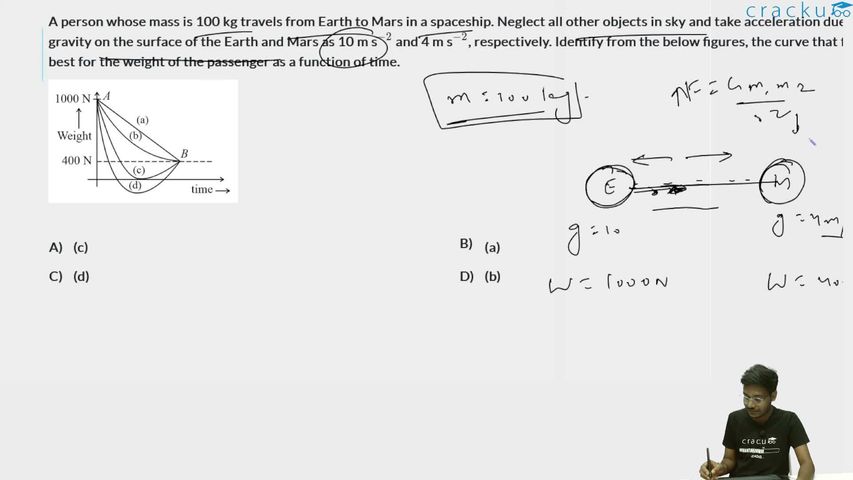
A person whose mass is 100 kg travels from Earth to Mars in a spaceship. Neglect all other objects in sky and take acceleration due to gravity on the surface of the Earth and Mars as 10 m s$$^{-2}$$ and 4 m s$$^{-2}$$, respectively. Identify from the below figures, the curve that fits best for the weight of the passenger as a function of time.
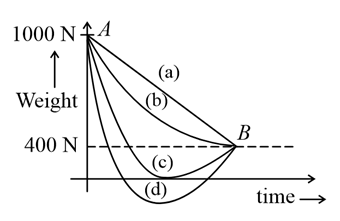
As the passenger travels from Earth to Mars, their weight $$W = mg$$ changes due to the variation in gravitational acceleration. On Earth's surface, $$W = 100 \times 10 = 1000$$ N. On Mars' surface, $$W = 100 \times 4 = 400$$ N.
As the spacecraft moves away from Earth, the gravitational pull of Earth decreases as $$\frac{1}{r^2}$$, so the weight decreases. At some point between Earth and Mars — the neutral point where Earth's gravitational pull equals Mars' gravitational pull — the weight becomes zero (the passenger is weightless).
After passing the neutral point, Mars' gravity becomes dominant and the weight starts increasing, eventually reaching 400 N at Mars' surface. Since Earth's surface gravity is stronger than Mars', the neutral point is closer to Mars, so the weight drops to zero more gradually and rises more quickly.
The correct curve starts at 1000 N, continuously decreases to zero at the neutral point, and then increases back to 400 N — corresponding to curve (c).
Was this solution helpful?
Click on the Email ☝️ to Watch the Video Solution
Create a FREE account and get:
_1.webp)

Educational materials for JEE preparation

Ask our AI anything

AI can make mistakes. Please verify important information.
AI can make mistakes. Please verify important information.


