
Join Our JEE Preparation Group
Prep with like-minded aspirants; Get access to free daily tests and study material.
Sign in
Please select an account to continue using cracku.in
↓ →
Join Our JEE Preparation Group
Prep with like-minded aspirants; Get access to free daily tests and study material.
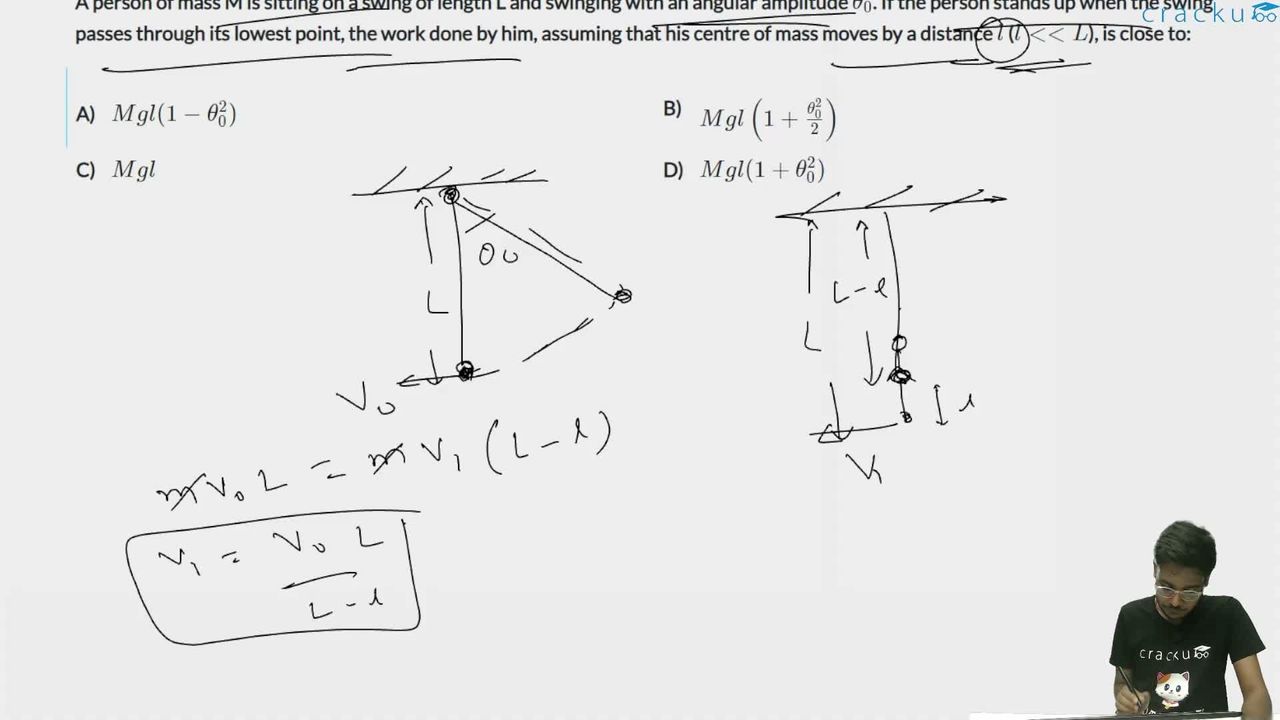
A person of mass M is sitting on a swing of length L and swinging with an angular amplitude $$\theta_0$$. If the person stands up when the swing passes through its lowest point, the work done by him, assuming that his centre of mass moves by a distance $$l$$ ($$l << L$$), is close to:
We treat the man-swing system as a simple pendulum whose bob (the person’s centre of mass while he is sitting) is at a distance $$L$$ from the pivot. The swing is released from an angular amplitude $$\theta_0$$ and reaches the lowest position (the vertical) with a certain speed. Exactly at this lowest point the person suddenly stands up, raising his centre of mass vertically by a small amount $$l$$ ($$l \ll L$$). We have to calculate the work that the person must do in order to achieve this rise and the accompanying change in kinetic energy of the swing.
First, let us find the speed just before the person stands up. Using mechanical-energy conservation for a pendulum of length $$L$$:
Initial potential energy (at amplitude $$\theta_0$$) relative to the lowest point is
$$U_i \;=\; MgL\bigl(1-\cos\theta_0\bigr).$$
At the lowest point this potential energy has completely converted into kinetic energy, so
$$\tfrac12 Mv_1^2 \;=\; MgL\bigl(1-\cos\theta_0\bigr).$$
Therefore the linear speed just before standing up is
$$v_1 \;=\; \sqrt{\,2gL\bigl(1-\cos\theta_0\bigr)}.$$
Now the person suddenly reduces the radius of circular motion from $$L$$ to
$$R_2 \;=\; L-l,$$
because his centre of mass rises by $$l$$. The interval in which he stands is taken to be very short, so the external torque about the pivot is practically zero (gravity acts along the vertical line through the pivot at that instant), and angular momentum about the pivot is conserved.
The angular momentum just before standing is
$$L_{\text{ang},1} \;=\; Mv_1 L.$$
Let the new speed immediately after standing be $$v_2$$. Conservation of angular momentum gives
$$Mv_1L \;=\; Mv_2\bigl(L-l\bigr)$$
$$\Longrightarrow\; v_2 \;=\; v_1\,\frac{L}{L-l}.$$
Hence the new kinetic energy is
$$K_2 = \tfrac12 Mv_2^2 = \tfrac12 Mv_1^2 \left(\frac{L}{L-l}\right)^2.$$
The potential energy has also increased, because the centre of mass is now higher by $$l$$. The increase in gravitational potential energy is
$$\Delta U \;=\; Mg\,l.$$
The work done by the person equals the total increase in mechanical energy, i.e.
$$W \;=\; (K_2 + U_2) - (K_1 + U_1) \;=\; (K_2 - K_1) + \Delta U.$$
Let us compute the kinetic-energy change:
$$K_2 - K_1 = \tfrac12 Mv_1^2\!\left[\left(\frac{L}{L-l}\right)^2 - 1\right].$$
Because $$l\ll L$$, we introduce the small parameter
$$\varepsilon \;=\; \frac{l}{L}, \quad\text{with } \varepsilon\ll 1.$$
Then $$\dfrac{L}{L-l} = \dfrac{1}{1-\varepsilon},$$ and for small $$\varepsilon$$ we use the binomial expansion
$$\frac{1}{1-\varepsilon} \;\approx\; 1 + \varepsilon + \varepsilon^2 + \ldots$$
Keeping only the first-order term,
$$\left(\frac{L}{L-l}\right)^2 = \frac{1}{(1-\varepsilon)^2} \;\approx\; 1 + 2\varepsilon.$$
Therefore
$$K_2 - K_1 \;\approx\; \tfrac12 Mv_1^2 (1 + 2\varepsilon - 1) = \tfrac12 Mv_1^2 (2\varepsilon) = Mv_1^2 \varepsilon.$$
Substituting $$\varepsilon = \dfrac{l}{L}$$ and $$v_1^2 = 2gL(1-\cos\theta_0),$$ we get
$$K_2 - K_1 = M \bigl[2gL(1-\cos\theta_0)\bigr]\frac{l}{L} = 2Mg(1-\cos\theta_0)\,l.$$
For small angular amplitudes we may use the standard approximation
$$\cos\theta_0 \;\approx\; 1 - \frac{\theta_0^{\,2}}{2},$$
so that
$$1-\cos\theta_0 \;\approx\; \frac{\theta_0^{\,2}}{2}.$$
Hence
$$K_2 - K_1 \;\approx\; 2Mg\left(\frac{\theta_0^{\,2}}{2}\right) l = Mg\theta_0^{\,2} l.$$
Now add the potential-energy change:
$$W = (K_2 - K_1) + \Delta U = Mg\theta_0^{\,2}l + Mg\,l = Mg\,l\,(1 + \theta_0^{\,2}).$$
Thus the work that the person has to do is approximately
$$W \;\approx\; Mg\,l\bigl(1 + \theta_0^{\,2}\bigr).$$
Hence, the correct answer is Option B.
Click on the Email ☝️ to Watch the Video Solution
Create a FREE account and get:
_1.webp)

Educational materials for JEE preparation

Ask our AI anything

AI can make mistakes. Please verify important information.
AI can make mistakes. Please verify important information.


