
Join Our JEE Preparation Group
Prep with like-minded aspirants; Get access to free daily tests and study material.
Sign in
Please select an account to continue using cracku.in
↓ →
Join Our JEE Preparation Group
Prep with like-minded aspirants; Get access to free daily tests and study material.
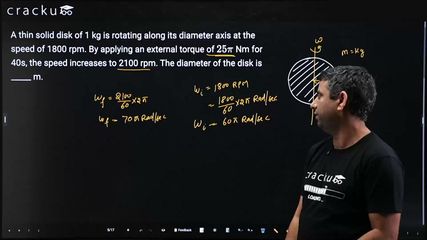
A thin solid disk of 1 kg is rotating along its diameter axis at the speed of 1800 rpm. By applying an external torque of $$25\pi$$ Nm for 40s, the speed increases to 2100 rpm. The diameter of the disk is _____ m.
Correct Answer: 40
The angular velocity of a rotating body is usually expressed in $$\text{rad s}^{-1}$$.
Given speeds in revolutions per minute (rpm) must first be converted.
Initial speed: $$1800\;\text{rpm} = 1800 \times \frac{2\pi\;\text{rad}}{60\;\text{s}} = 60\pi\;\text{rad s}^{-1}$$.
Final speed: $$2100\;\text{rpm} = 2100 \times \frac{2\pi\;\text{rad}}{60\;\text{s}} = 70\pi\;\text{rad s}^{-1}$$.
The change in angular velocity is therefore
$$\Delta\omega = \omega_f - \omega_i = 70\pi - 60\pi = 10\pi\;\text{rad s}^{-1}$$.
Torque and angular momentum are related through the angular impulse equation:
$$\tau\,t = \Delta L = I\,\Delta\omega$$ $$-(1)$$,
where $$I$$ is the moment of inertia about the rotation axis.
Given values: $$\tau = 25\pi\;\text{N m}$$ and $$t = 40\;\text{s}$$.
Hence the angular impulse is
$$\tau t = 25\pi \times 40 = 1000\pi\;\text{kg m}^2\text{s}^{-1}$$.
Substituting into $$(1)$$ gives
$$I \times 10\pi = 1000\pi$$.
Cancel $$\pi$$ and solve for $$I$$:
$$I = \frac{1000}{10} = 100\;\text{kg m}^2$$.
The axis of rotation is a diameter lying in the plane of the thin solid disk.
For a uniform disk about a diameter, the moment of inertia is
$$I = \frac{1}{4} M R^2$$ $$-(2)$$,
where $$M$$ is the mass and $$R$$ the radius.
With $$M = 1\;\text{kg}$$, substitute $$I = 100\;\text{kg m}^2$$ into $$(2)$$:
$$100 = \frac{1}{4} \times 1 \times R^2 \quad\Longrightarrow\quad R^2 = 400$$.
Thus $$R = 20\;\text{m}$$.
The diameter is twice the radius:
Diameter $$= 2R = 2 \times 20 = 40\;\text{m}$$.
Final Answer: 40 m
Was this solution helpful?
Click on the Email ☝️ to Watch the Video Solution
Create a FREE account and get:
_1.webp)

Educational materials for JEE preparation

Ask our AI anything

AI can make mistakes. Please verify important information.
AI can make mistakes. Please verify important information.
