
Join Our JEE Preparation Group
Prep with like-minded aspirants; Get access to free daily tests and study material.
Sign in
Please select an account to continue using cracku.in
↓ →
Join Our JEE Preparation Group
Prep with like-minded aspirants; Get access to free daily tests and study material.
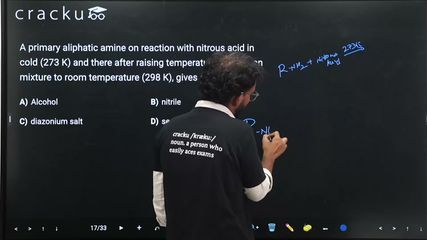
A primary aliphatic amine on reaction with nitrous acid in cold (273 K) and there after raising temperature of reaction mixture to room temperature (298 K), gives a/an
When a primary aliphatic amine reacts with nitrous acid ($$HNO_2$$) in cold conditions (273 K) and the temperature is then raised to room temperature (298 K), the initial reaction at low temperature involves a primary aliphatic amine ($$R-NH_2$$) reacting with nitrous acid (prepared in situ from $$NaNO_2 + HCl$$) to form an aliphatic diazonium salt:
$$R-NH_2 + HNO_2 \rightarrow R-N_2^+Cl^- + H_2O$$
Aliphatic diazonium salts are extremely unstable and decompose immediately even at low temperatures. Upon warming to room temperature (298 K), the diazonium salt loses nitrogen:
$$R-N_2^+Cl^- \xrightarrow{298 K} R^+ + N_2 \uparrow$$
The resulting carbocation reacts with water to give an alcohol:
$$R^+ + H_2O \rightarrow R-OH + H^+$$
Overall, the primary aliphatic amine is converted into an alcohol with the evolution of nitrogen gas:
$$R-NH_2 \xrightarrow{NaNO_2/HCl, 273K \rightarrow 298K} R-OH + N_2 + HCl$$
This behavior contrasts with that of aromatic primary amines, which form stable diazonium salts at 273 K that can undergo coupling reactions. The correct answer is Option A: Alcohol.
Was this solution helpful?
Click on the Email ☝️ to Watch the Video Solution
Create a FREE account and get:
_1.webp)

Educational materials for JEE preparation

Ask our AI anything

AI can make mistakes. Please verify important information.
AI can make mistakes. Please verify important information.
