
Join Our JEE Preparation Group
Prep with like-minded aspirants; Get access to free daily tests and study material.
Sign in
Please select an account to continue using cracku.in
↓ →
Join Our JEE Preparation Group
Prep with like-minded aspirants; Get access to free daily tests and study material.
A solid sphere with uniform density and radius R is rotating initially with constant angular velocity ($$\omega_1$$) about its diameter. After some time during the rotation its starts loosing mass at a uniform rate, with no change in its shape. The angular velocity of the sphere when its radius become R/2 is $$x\omega_1$$. The value of x is ______.
Correct Answer: 32
Let the initial mass of the solid sphere be $$M$$ and its initial radius be $$R$$. Moment of inertia of a solid sphere about any diameter is
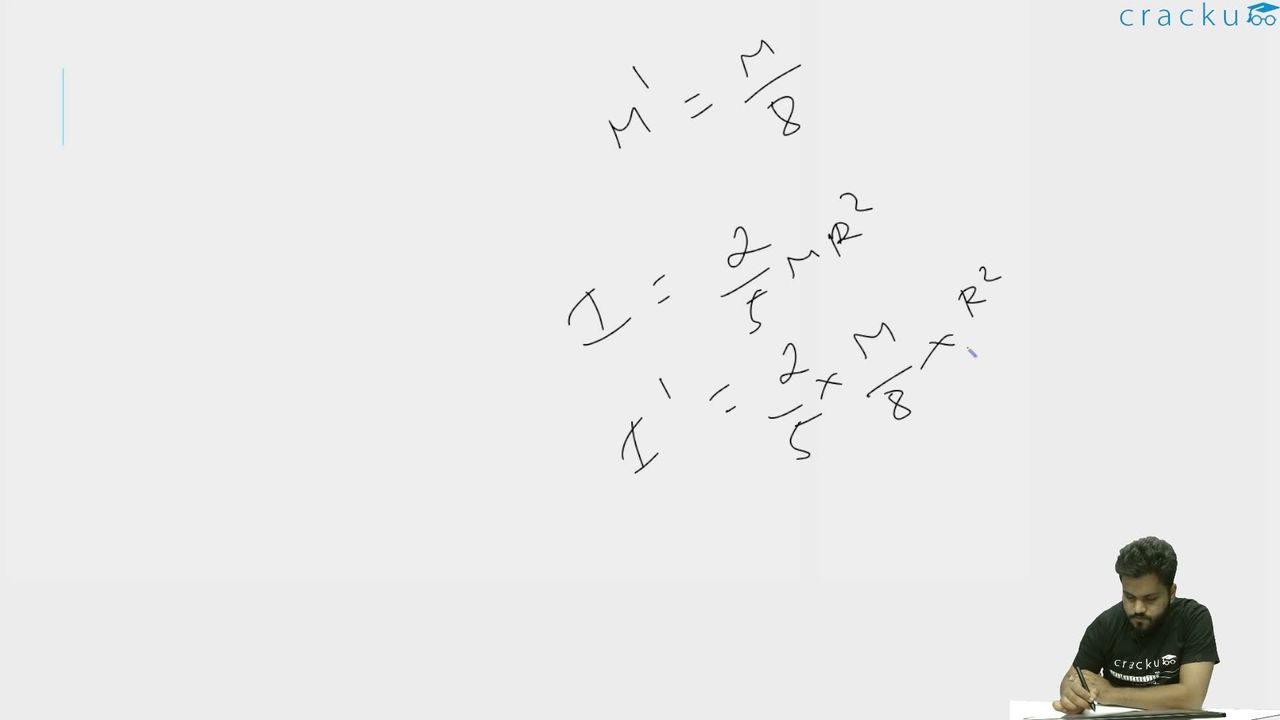
$$I=\frac{2}{5}MR^{2}$$ $$-(1)$$
When the sphere loses mass it keeps its shape, so it remains a uniform solid sphere of a smaller radius. If the radius becomes $$\frac{R}{2}$$, the new volume is
$$V'=\frac{4}{3}\pi\left(\frac{R}{2}\right)^{3}=\frac{1}{8}\left(\frac{4}{3}\pi R^{3}\right)$$
With uniform density, mass is proportional to volume, hence
$$M'=\frac{1}{8}M$$ $$-(2)$$
The new moment of inertia about the same diameter is
$$I'=\frac{2}{5}M'\left(\frac{R}{2}\right)^{2} =\frac{2}{5}\left(\frac{M}{8}\right)\left(\frac{R^{2}}{4}\right) =\frac{2}{5}MR^{2}\left(\frac{1}{32}\right) =\frac{I}{32}$$ $$-(3)$$
The mass is lost symmetrically, so no external torque acts on the sphere. Therefore the angular momentum about the diameter remains constant:
$$I\omega_{1}=I'\omega_{2}$$ $$-(4)$$
Substituting $$I'=\frac{I}{32}$$ from $$(3)$$ into $$(4)$$, we get
$$I\omega_{1}=\frac{I}{32}\,\omega_{2} \;\;\Longrightarrow\;\; \omega_{2}=32\,\omega_{1}$$
Comparing with $$\omega_{2}=x\omega_{1}$$, we find
$$x=32$$
Hence, the angular velocity of the sphere when its radius becomes $$R/2$$ is $$32\omega_{1}$$ and the required value of $$x$$ is 32.
Was this solution helpful?
Click on the Email ☝️ to Watch the Video Solution
Create a FREE account and get:
_1.webp)

Educational materials for JEE preparation

Ask our AI anything

AI can make mistakes. Please verify important information.
AI can make mistakes. Please verify important information.
