
Join Our JEE Preparation Group
Prep with like-minded aspirants; Get access to free daily tests and study material.
Sign in
Please select an account to continue using cracku.in
↓ →
Join Our JEE Preparation Group
Prep with like-minded aspirants; Get access to free daily tests and study material.
An annular disc of inner radius $$R$$ and outer radius $$2R$$ has uniform charge density $$\sigma$$. It is rotating about the axis passing through the center and perpendicular to its plane with angular velocity $$\omega$$. If the magnetic field at the center of the ring is $$\frac{\mu_0\sigma\omega R}{n},$$ then find $$n$$.
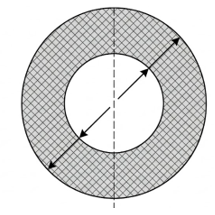
Correct Answer: 2
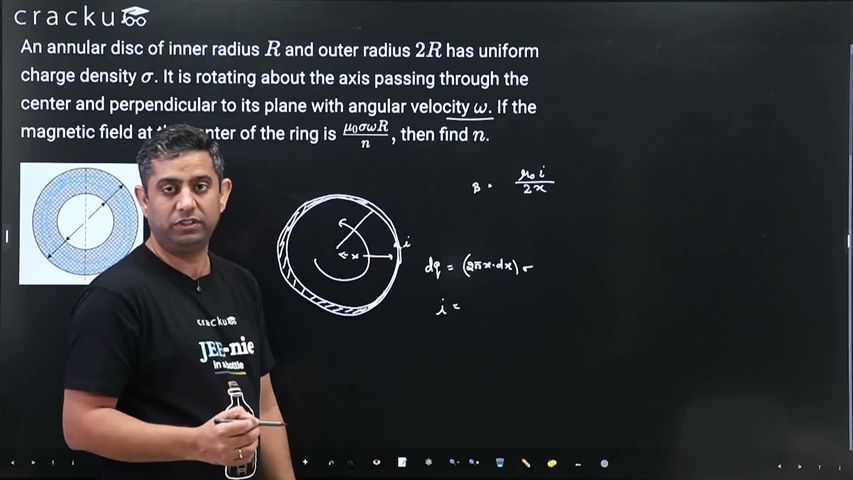
Consider a small circular ring of radius $$r$$ and thickness $$dr$$.
Its charge is $$dq=\sigma(2\pi r\,dr)$$
Since the disc rotates with angular velocity $$\omega$$, the time taken for one revolution is $$T=\frac{2\pi}{\omega}$$
Hence, the current due to this small ring is $$dI=\frac{dq}{T}$$
$$dI=\frac{\sigma(2\pi r\,dr)\omega}{2\pi}$$
$$dI=\sigma\omega r\,dr$$
The magnetic field at the centre due to a circular ring is $$dB=\frac{\mu_0dI}{2r}$$
Therefore, $$dB=\frac{\mu_0\sigma\omega r\,dr}{2r}$$
$$dB=\frac{\mu_0\sigma\omega}{2}\,dr$$
The annular disc extends from $$r=R$$ to $$r=2R$$.
Hence, $$B=\int_R^{2R}dB$$
$$B=\frac{\mu_0\sigma\omega}{2}\int_R^{2R}dr$$
$$B=\frac{\mu_0\sigma\omega}{2}(2R-R)$$
$$B=\frac{\mu_0\sigma\omega R}{2}$$
Given, $$B=\frac{\mu_0\sigma\omega R}{n}$$
Comparing, $$\frac{1}{n}=\frac{1}{2}$$
Therefore, $${n=2}$$
Hence, the correct answer is 2.
Click on the Email ☝️ to Watch the Video Solution
Create a FREE account and get:
_1.webp)

Educational materials for JEE preparation

Ask our AI anything

AI can make mistakes. Please verify important information.
AI can make mistakes. Please verify important information.


