
Join Our JEE Preparation Group
Prep with like-minded aspirants; Get access to free daily tests and study material.
Sign in
Please select an account to continue using cracku.in
↓ →
Join Our JEE Preparation Group
Prep with like-minded aspirants; Get access to free daily tests and study material.
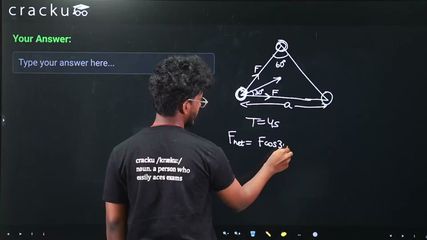
Three identical spheres of mass m, are placed at the vertices of an equilateral triangle of length a. When released, they interact only through gravitational force and collide after a time $$T = 4$$ seconds. If the sides of the triangle are increased to length 2a and also the masses of the spheres are made 2m, then they will collide after _________ seconds.
Correct Answer: 8
The only quantities that decide the collapse-time for three identical masses released from the corners of an equilateral triangle are
• the initial side length $$a$$,
• the mass of each sphere $$m$$,
• the universal constant of gravitation $$G$$.
Let the required time be $$T$$. Assume a dependence of the form
$$T \propto G^{\,p}\,m^{\,q}\,a^{\,r}$$
Write dimensions (M ≡ mass, L ≡ length, T ≡ time):
$$[T] = T^{1},\quad [G]=L^{3}M^{-1}T^{-2},\quad [m]=M^{1},\quad [a]=L^{1}$$
Equating powers of the fundamental dimensions,
$$L: \; 0 = 3p + r$$ $$M: \; 0 = -p + q$$ $$T: \; 1 = -2p$$
Solving,
$$p = -\frac12,\quad q = -\frac12,\quad r = \frac32$$
Hence
$$T \propto G^{-1/2}\,m^{-1/2}\,a^{3/2} \;=\;k\,\sqrt{\dfrac{a^{3}}{G\,m}}$$
for some dimensionless constant $$k$$ that is the same for both experiments because the geometry is identical.
Initial situation: side $$=a$$, mass $$=m$$, time $$=T = 4\,$$s.
New situation: side $$=2a$$, mass $$=2m$$. Using the proportionality,
$$\dfrac{T'}{T}=\dfrac{\sqrt{(2a)^{3}/(G\,2m)}}{\sqrt{a^{3}/(G\,m)}}$$
$$\qquad=\,\dfrac{2^{3/2}}{2^{1/2}} = 2$$
Therefore $$T' = 2T = 2 \times 4\text{ s} = 8\text{ s}$$.
So the three spheres will collide after 8 seconds.
Was this solution helpful?
Click on the Email ☝️ to Watch the Video Solution
Create a FREE account and get:
_1.webp)

Educational materials for JEE preparation

Ask our AI anything

AI can make mistakes. Please verify important information.
AI can make mistakes. Please verify important information.


