
Join Our JEE Preparation Group
Prep with like-minded aspirants; Get access to free daily tests and study material.
Sign in
Please select an account to continue using cracku.in
↓ →
Join Our JEE Preparation Group
Prep with like-minded aspirants; Get access to free daily tests and study material.
An electron is released from rest near an infinite non-conducting sheet of uniform charge density '$$-\sigma$$'. The rate of change of de-Broglie wave length associated with the electron varies inversely as $$n^{th}$$ power of time. The numerical value of n is _____.
Correct Answer: 2
An infinite non-conducting sheet having uniform surface charge density $$-\sigma$$ produces a uniform electric field of magnitude
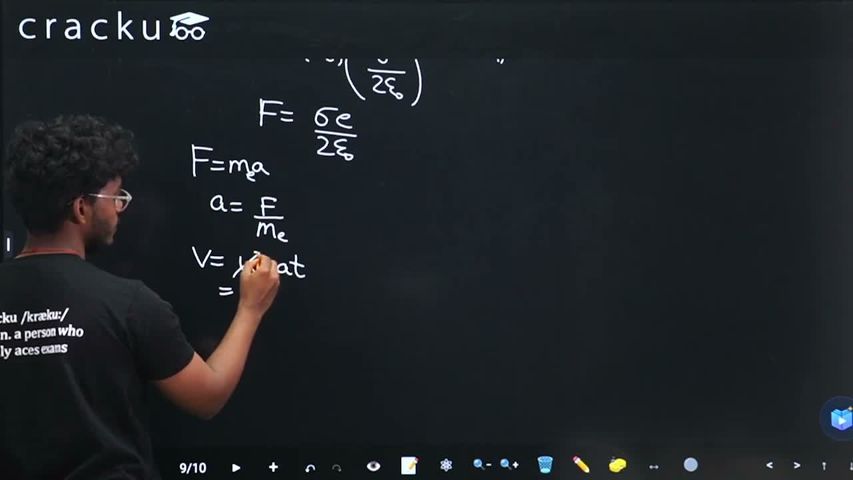
$$E=\frac{\sigma}{2\varepsilon_0} \quad -(1)$$
The field lines point toward the sheet because $$\sigma$$ is negative.
Charge on an electron $$q=-e$$, so the force on the electron is
$$F = qE = (-e)\,E = e\,\frac{\sigma}{2\varepsilon_0}$$ away from the sheet. Its magnitude is
$$|F| = \frac{e|\sigma|}{2\varepsilon_0} \quad -(2)$$
Using Newton’s second law, the magnitude of the constant acceleration is
$$a = \frac{|F|}{m} = \frac{e|\sigma|}{2\varepsilon_0 m} \quad -(3)$$
The electron is released from rest, so its speed after time $$t$$ is obtained from the kinematic relation $$v = at$$:
$$v = a t \quad -(4)$$
The de-Broglie wavelength is defined as $$\lambda = \frac{h}{p}=\frac{h}{mv}$$. Substituting $$v$$ from $$(4)$$ gives
$$\lambda = \frac{h}{m (a t)} = \frac{h}{m a}\,\frac{1}{t} \quad -(5)$$
Thus $$\lambda$$ is inversely proportional to time. Differentiate $$(5)$$ with respect to $$t$$:
$$\frac{d\lambda}{dt} = -\frac{h}{m a}\,\frac{1}{t^{2}} \quad -(6)$$
Equation $$(6)$$ shows that the rate of change of the de-Broglie wavelength varies as $$t^{-2}$$.
Therefore, the required power $$n=2$$.
Final answer: $$n = 2$$.
Was this solution helpful?
Click on the Email ☝️ to Watch the Video Solution
Create a FREE account and get:
_1.webp)

Educational materials for JEE preparation

Ask our AI anything

AI can make mistakes. Please verify important information.
AI can make mistakes. Please verify important information.
