
Join Our JEE Preparation Group
Prep with like-minded aspirants; Get access to free daily tests and study material.
Sign in
Please select an account to continue using cracku.in
↓ →
Join Our JEE Preparation Group
Prep with like-minded aspirants; Get access to free daily tests and study material.
The following complexes $$[CoCl(NH_3)_5]^{2+}$$ (A), $$[Co(CN)_6]^{3-}$$ (B), $$[Co(NH_3)_5(H_2O)]^{3+}$$ (C), $$[Cu(H_2O)_4]^{2+}$$ (D). The correct order of A, B, C and D in terms of wavenumber of light absorbed is :
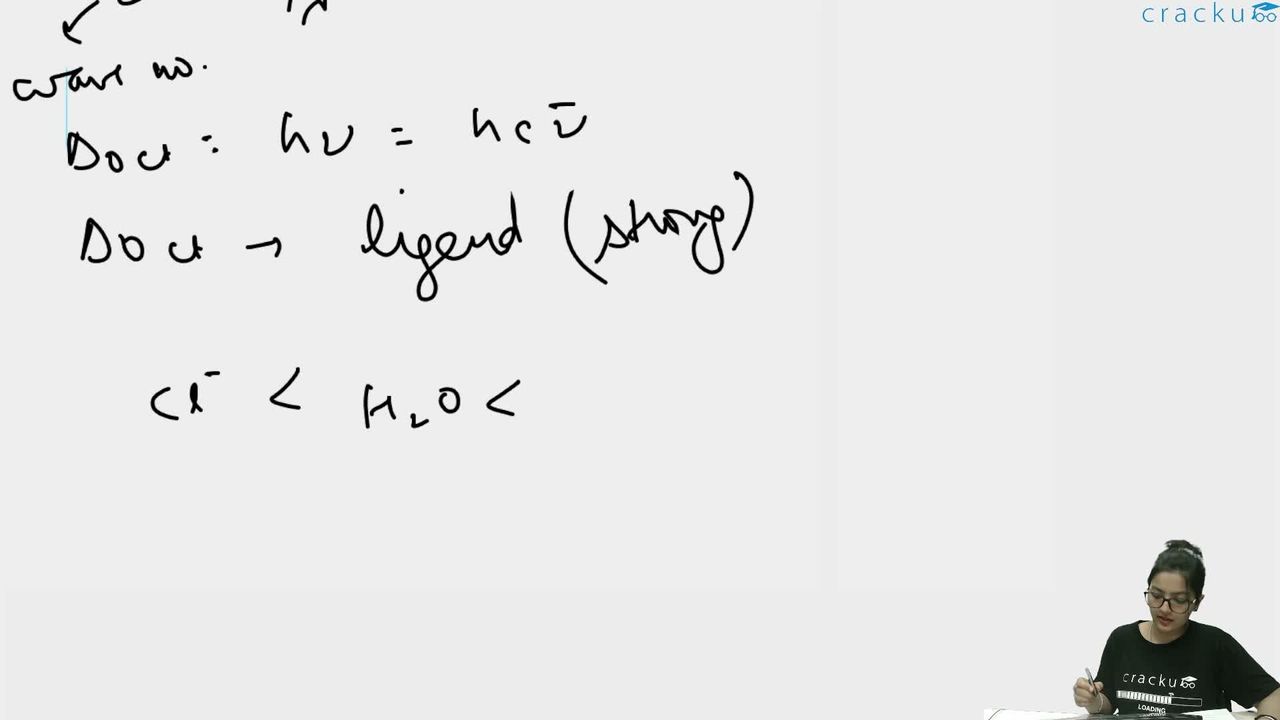
The colour shown by a transition-metal complex depends on the energy gap $$\Delta_{oct}$$ between its two d-electron sets. The light absorbed has frequency $$\nu$$ (or wavenumber $$\tilde{\nu}=1/\lambda$$) given by $$\Delta_{oct}=h\nu=hc\tilde{\nu}$$. Therefore:
larger $$\Delta_{oct}\;\Longrightarrow\;$$ higher energy $$\Longrightarrow\;$$ higher frequency $$\Longrightarrow\;$$ higher wavenumber of light absorbed.
Two main factors decide the magnitude of $$\Delta_{oct}$$:
1. Nature of ligands (spectrochemical series)
Weak-field ligands give small $$\Delta_{oct}$$, strong-field ligands give large $$\Delta_{oct}$$.
$$Cl^- \lt H_2O \lt NH_3 \lt CN^-$$ in ligand strength.
2. Oxidation state of the metal ion For the same ligands, a higher positive charge on the metal pulls the ligands closer, increasing $$\Delta_{oct}$$.
Let us analyse each complex.
Case A: $$[CoCl(NH_3)_5]^{2+}$$
Co is in $$+3$$ oxidation state (because $$x + (-1) = +2 \Rightarrow x = +3$$). It has five moderate ligands $$NH_3$$ and one weak ligand $$Cl^-$$, so the overall ligand field is weaker than that produced by six $$NH_3$$ molecules.
Case B: $$[Co(CN)_6]^{3-}$$
Co is again $$+3$$. The ligand $$CN^-$$ is a very strong-field ligand. Hence $$\Delta_{oct}$$ is the largest among the four complexes.
Case C: $$[Co(NH_3)_5(H_2O)]^{3+}$$
Co is $$+3$$. There are five $$NH_3$$ (stronger than $$H_2O$$) and one $$H_2O$$. Because $$H_2O$$ is stronger than $$Cl^-$$, the average ligand field here is stronger than in Case A but weaker than in Case B.
Case D: $$[Cu(H_2O)_4]^{2+}$$
Cu is only in the $$+2$$ state, and the ligands are the medium-weak $$H_2O$$. The smaller oxidation state and weaker ligand field give the smallest $$\Delta_{oct}$$. (The geometry is tetragonally distorted octahedral or square-planar, but either way the splitting is smaller than that for the Co$$^{3+}$$ complexes.)
Combining the above comparisons:
$$\Delta_{oct}(D) \lt \Delta_{oct}(A) \lt \Delta_{oct}(C) \lt \Delta_{oct}(B)$$
Since wavenumber of absorbed light is directly proportional to $$\Delta_{oct}$$, the same order applies to $$\tilde{\nu}\,(\text{absorbed})$$:
$$[Cu(H_2O)_4]^{2+} \; \lt \; [CoCl(NH_3)_5]^{2+} \; \lt \; [Co(NH_3)_5(H_2O)]^{3+} \; \lt \; [Co(CN)_6]^{3-}$$
Hence the correct order is D < A < C < B, which corresponds to Option D.
Was this solution helpful?
Click on the Email ☝️ to Watch the Video Solution
Create a FREE account and get:
Educational materials for JEE preparation

Ask our AI anything

AI can make mistakes. Please verify important information.
AI can make mistakes. Please verify important information.

_1.webp)
