
Join Our JEE Preparation Group
Prep with like-minded aspirants; Get access to free daily tests and study material.
Sign in
Please select an account to continue using cracku.in
↓ →
Join Our JEE Preparation Group
Prep with like-minded aspirants; Get access to free daily tests and study material.
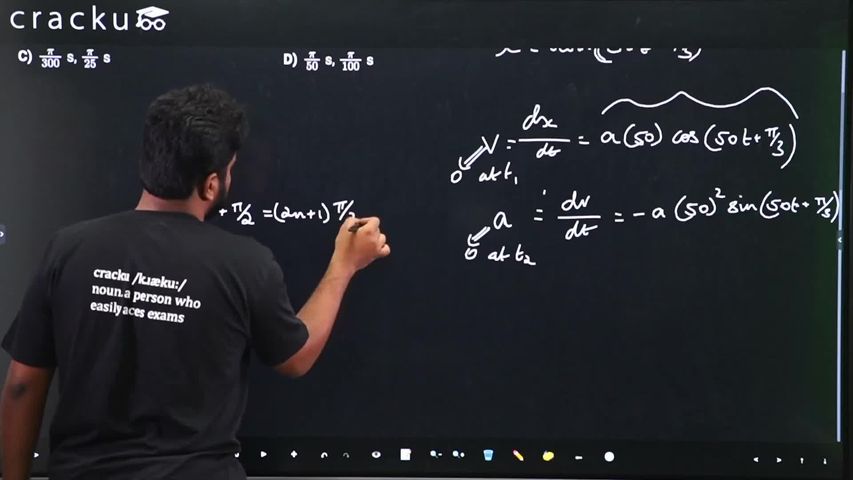
The equation of motion of a particle is given by $$x = a\sin\left(50t + \frac{\pi}{3}\right)$$ cm. The particle will come to rest at time $$t_1$$ and it will have zero acceleration at time $$t_2$$. The $$t_1$$ and $$t_2$$ respectively are _____.
The displacement of the particle is given by $$x = a \sin\!\left(50t + \frac{\pi}{3}\right) \text{ cm}$$.
For any simple harmonic motion $$x = a \sin(\omega t + \phi)$$, the angular frequency is $$\omega$$.
Here $$\omega = 50 \, \text{rad s}^{-1}$$.
Time $$t_1$$ when the particle comes to rest (velocity $$v = 0$$)
Velocity is the first derivative of displacement:
$$v = \frac{dx}{dt} = a \cdot 50 \cos\!\left(50t + \frac{\pi}{3}\right).$$
Set $$v = 0$$:
$$\cos\!\left(50t + \frac{\pi}{3}\right) = 0.$$
Cosine is zero at odd multiples of $$\frac{\pi}{2}$$, so
$$50t + \frac{\pi}{3} = \left(2n + 1\right)\frac{\pi}{2},\;\; n \in \mathbb{Z}.$$
Choosing the smallest positive time means taking $$n = 0$$:
$$50t_1 + \frac{\pi}{3} = \frac{\pi}{2}$$
$$\Rightarrow\; 50t_1 = \frac{\pi}{2} - \frac{\pi}{3} = \frac{\pi}{6}$$
$$\Rightarrow\; t_1 = \frac{\pi}{6}\,\frac{1}{50} = \frac{\pi}{300}\;\text{s}.$$
Time $$t_2$$ when the acceleration is zero (acceleration $$a_x = 0$$)
Acceleration is the second derivative of displacement:
$$a_x = \frac{d^2x}{dt^2} = -\,50^2 a \sin\!\left(50t + \frac{\pi}{3}\right).$$
Set $$a_x = 0$$:
$$\sin\!\left(50t + \frac{\pi}{3}\right) = 0.$$
Sine is zero at integral multiples of $$\pi$$, so
$$50t + \frac{\pi}{3} = n\pi,\;\; n \in \mathbb{Z}.$$
The smallest positive time occurs for $$n = 1$$ (because $$n = 0$$ gives a negative time):
$$50t_2 + \frac{\pi}{3} = \pi$$
$$\Rightarrow\; 50t_2 = \pi - \frac{\pi}{3} = \frac{2\pi}{3}$$
$$\Rightarrow\; t_2 = \frac{2\pi}{3}\,\frac{1}{50} = \frac{\pi}{75}\;\text{s}.$$
Therefore, $$t_1 = \frac{\pi}{300}\,\text{s}$$ and $$t_2 = \frac{\pi}{75}\,\text{s}$$.
Option A: $$\frac{\pi}{300}\, \text{s},\; \frac{\pi}{75}\, \text{s}$$ is correct.
Click on the Email ☝️ to Watch the Video Solution
Create a FREE account and get:
_1.webp)

Educational materials for JEE preparation

Ask our AI anything

AI can make mistakes. Please verify important information.
AI can make mistakes. Please verify important information.


