
Join Our JEE Preparation Group
Prep with like-minded aspirants; Get access to free daily tests and study material.
Sign in
Please select an account to continue using cracku.in
↓ →
Join Our JEE Preparation Group
Prep with like-minded aspirants; Get access to free daily tests and study material.
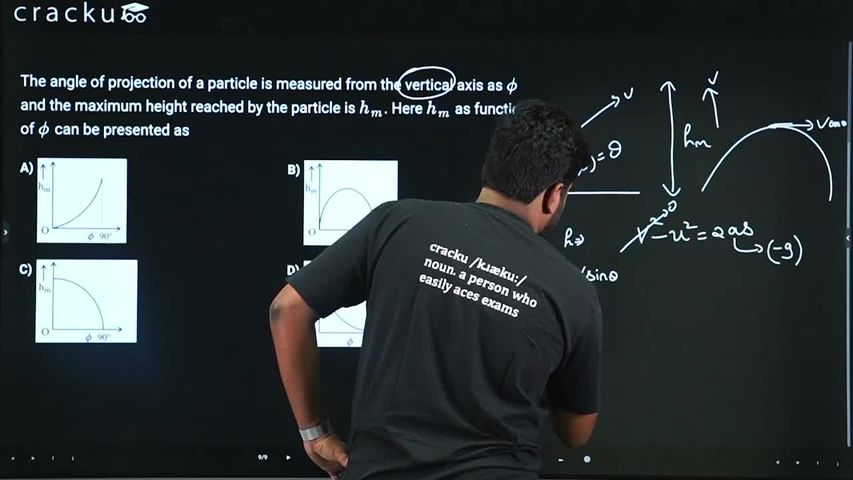
The angle of projection of a particle is measured from the vertical axis as $$\phi$$ and the maximum height reached by the particle is $$h_m$$. Here $$h_m$$ as function of $$\phi$$ can be presented as
given
angle φ is measured from vertical
so convert to usual projectile angle θ (from horizontal):
θ = 90° − φ
maximum height formula:
hₘ = (u² sin²θ) / (2g)
substitute θ:
hₘ = (u² sin²(90° − φ)) / (2g)
use identity:
sin(90° − φ) = cosφ
so,
hₘ = (u² cos²φ) / (2g)
so relation is:
hₘ ∝ cos²φ
now understand behavior of cos²φ
when φ = 0°
cosφ = 1 → hₘ is maximum
when φ increases
cosφ decreases → hₘ decreases
when φ = 90°
cosφ = 0 → hₘ = 0
so graph must:
start at maximum value at φ = 0
decrease continuously
reach zero at φ = 90°
shape:
cos²φ decreases slowly at first, then faster
so curve is downward bending (not straight)
check options:
A → increasing → wrong
B → goes up then down → wrong
C → starts high, smoothly decreases to zero → correct
D → decreases too sharply like exponential → wrong
final answer: C
Was this solution helpful?
Click on the Email ☝️ to Watch the Video Solution
Create a FREE account and get:
_1.webp)

Educational materials for JEE preparation

Ask our AI anything

AI can make mistakes. Please verify important information.
AI can make mistakes. Please verify important information.


