
Join Our JEE Preparation Group
Prep with like-minded aspirants; Get access to free daily tests and study material.
Sign in
Please select an account to continue using cracku.in
↓ →
Join Our JEE Preparation Group
Prep with like-minded aspirants; Get access to free daily tests and study material.
A force of 49 N acts tangentially at the highest point of a sphere (solid) of mass 20 kg, kept on a rough horizontal plane. If the sphere rolls without slipping, then the acceleration of the center of the sphere is
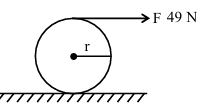
The force $$F$$ is applied at the highest point of the sphere. Taking torque about the point of contact with the ground, the friction force produces no torque.
The perpendicular distance of the force from the point of contact is $$2r$$. Therefore, $$F(2r)=I_P\alpha$$
Using the parallel-axis theorem, $$I_P=I+mr^2$$
For a solid sphere, $$I=\frac{2}{5}mr^2$$
Therefore, $$I_P=\frac{2}{5}mr^2+mr^2=\frac{7}{5}mr^2$$
Using the rolling condition, $$\alpha=\frac{a}{r}$$
Hence, $$F(2r)=\frac{7}{5}mr^2\frac{a}{r}$$
$$2F=\frac{7}{5}ma$$
Therefore, $$a=\frac{10F}{7m}$$
Substituting $$F=49\,N$$ and $$m=20\,kg$$,
$$a=\frac{10\times49}{7\times20}$$
$$a=3.5\,m/s^2$$
Therefore, $${a=3.5\,m/s^2}$$
Hence, the correct option is A.

Click on the Email ☝️ to Watch the Video Solution
Create a FREE account and get:
_1.webp)

Educational materials for JEE preparation

Ask our AI anything

AI can make mistakes. Please verify important information.
AI can make mistakes. Please verify important information.


