
Join Our JEE Preparation Group
Prep with like-minded aspirants; Get access to free daily tests and study material.
Sign in
Please select an account to continue using cracku.in
↓ →
Join Our JEE Preparation Group
Prep with like-minded aspirants; Get access to free daily tests and study material.
Two known resistances of $$R \Omega$$ and $$2R \Omega$$ and one unknown resistance $$X \Omega$$ are connected in a circuit as shown in the figure. If the equivalent resistance between points A and B in the circuit is $$X \Omega$$, then the value of X is __________ $$\Omega$$.
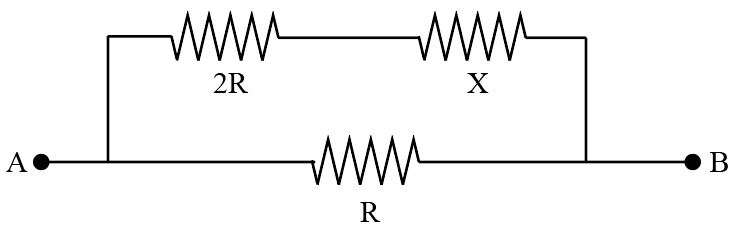
From the diagram, there are two parallel paths between A and B:
• bottom branch: just R
• top branch: 2R in series with X → total = 2R + X
So equivalent resistance:
$$R_{eq}=\frac{\left(R(2R+X)\right)}{(R+2R+X)}$$
Given: Req = X
So,
$$R(2R+X)/(3R+X)=X$$
Cross-multiply:
$$R(2R+X)=X(3R+X)$$
Expand:
$$2R^2+RX=3RX+X^2$$
Bring everything to one side:
$$2R^2+RX−3RX−X^2=0$$
$$2R^2−2RX−X^2=0$$
Rearrange:
$$X^2+2RX−2R^2=0$$
Now solve quadratic in X:
$$X=[−2R\pm\sqrt{(4R^2+8R^2)}]/2$$
$$X=[−2R\pm\sqrt{\ 12R^2}]/2$$
$$X=[−2R\pm2\sqrt{3}R]/2$$
$$X=−R\pm\sqrt{3}R$$
Physical resistance must be positive, so:
$$X=R(\sqrt{3}−1)$$
Was this solution helpful?
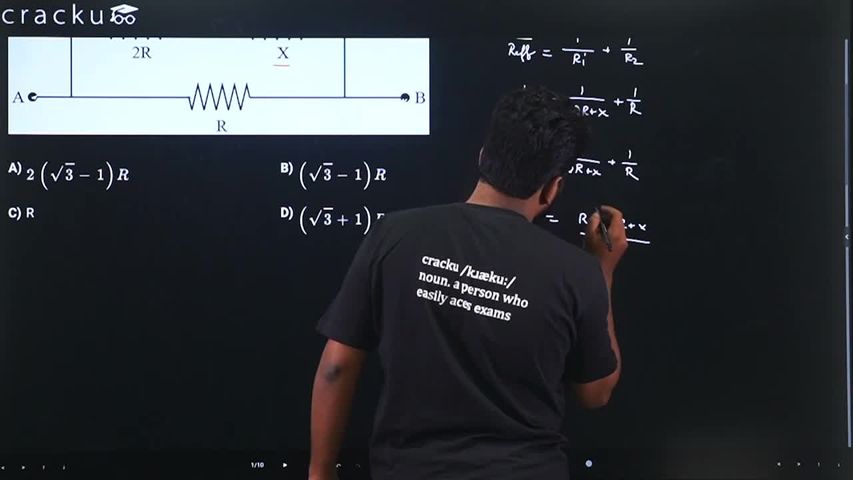
Click on the Email ☝️ to Watch the Video Solution
Create a FREE account and get:
_1.webp)

Educational materials for JEE preparation

Ask our AI anything

AI can make mistakes. Please verify important information.
AI can make mistakes. Please verify important information.
