
Join Our JEE Preparation Group
Prep with like-minded aspirants; Get access to free daily tests and study material.
Sign in
Please select an account to continue using cracku.in
↓ →
Join Our JEE Preparation Group
Prep with like-minded aspirants; Get access to free daily tests and study material.
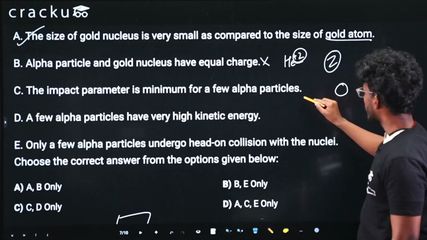
In Rutherford's alpha-particle scattering experiment, only a few alpha particles rebound back because
A. The size of gold nucleus is very small as compared to the size of gold atom.
B. Alpha particle and gold nucleus have equal charge.
C. The impact parameter is minimum for a few alpha particles.
D. A few alpha particles have very high kinetic energy.
E. Only a few alpha particles undergo head-on collision with the nuclei.
Choose the correct answer from the options given below:
The question asks why, in Rutherford’s gold-foil experiment, only a very small fraction of incident $$\alpha$$-particles are scattered backward (rebound through angles $$\gt 90^{\circ}$$).
To answer, recall two key ideas of Rutherford scattering:
1. The nuclear size is extremely small compared with the atomic size.
2. Large deflection (up to $$180^{\circ}$$) occurs only when the $$\alpha$$-particle passes very close to the nucleus, i.e. the impact parameter $$b$$ is extremely small. Such trajectories are often called “head-on” or “near head-on” collisions.
Using these ideas, examine each statement:
Statement A: “The gold nucleus is very small compared to the atom.”
Because the nucleus occupies only about $$10^{-15}\text{ m}$$ while the atom is about $$10^{-10}\text{ m}$$, the geometrical area that can give large deflection is tiny. Hence very few $$\alpha$$-particles come close enough to rebound. Statement A is correct.
Statement B: “$$\alpha$$-particle and gold nucleus have equal charge.”
The charges are $$+2e$$ for an $$\alpha$$-particle and $$+79e$$ for a gold nucleus; they are not equal. Therefore Statement B is wrong.
Statement C: “Impact parameter is minimum for very few particles.”
The distribution of $$\alpha$$-particles over the foil is uniform, so only a minute fraction possess a sufficiently small impact parameter $$b$$ ($$b \approx 0$$) required for large-angle scattering. Hence Statement C is correct.
Statement D: “Very few $$\alpha$$-particles have very high kinetic energy.”
All $$\alpha$$-particles in Rutherford’s beam are emitted from the same radioactive source and have nearly the same kinetic energy. The fraction with “very high” energy is not the reason for rare back-scattering. Statement D is wrong.
Statement E: “Only few $$\alpha$$-particles undergo head-on collision.”
A head-on collision corresponds to $$b \approx 0$$ and produces a $$180^{\circ}$$ reversal. Since $$b \approx 0$$ events are rare, only a few $$\alpha$$-particles rebound. Statement E is correct.
Thus the correct set of reasons is A, C, and E.
Therefore, the correct option is
Option D which is: A, C, E Only.
Was this solution helpful?
Click on the Email ☝️ to Watch the Video Solution
Create a FREE account and get:
_1.webp)

Educational materials for JEE preparation

Ask our AI anything

AI can make mistakes. Please verify important information.
AI can make mistakes. Please verify important information.


