
Join Our JEE Preparation Group
Prep with like-minded aspirants; Get access to free daily tests and study material.
Sign in
Please select an account to continue using cracku.in
↓ →
Join Our JEE Preparation Group
Prep with like-minded aspirants; Get access to free daily tests and study material.
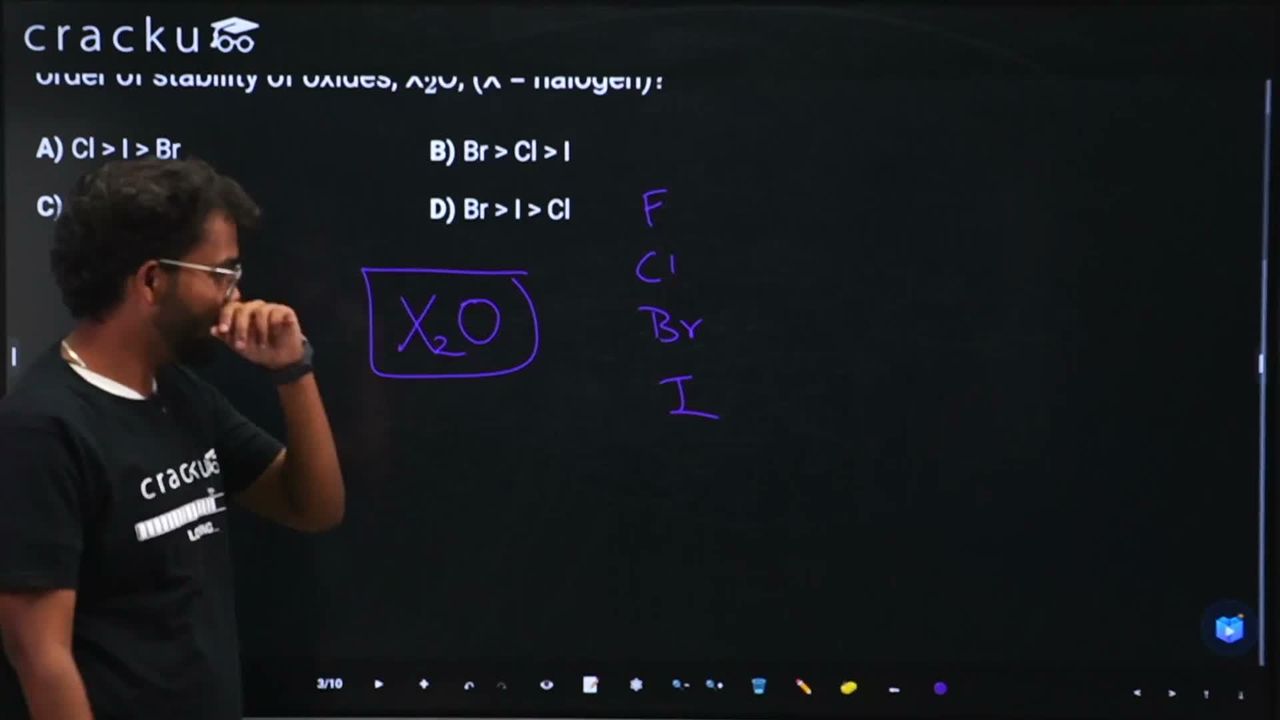
Which one of the following correctly represents the order of stability of oxides, X$$_2$$O; (X = halogen)?
We have to compare the relative stability of the monoxides $$\mathrm{X_2O}$$ in which the halogen atom X is present in the $$+1$$ oxidation state. The factors that mainly decide the stability are
1. The ease with which the halogen can exist in a positive oxidation state.
2. The strength of the X-O bond that actually holds the molecule together.
First, let us examine the ease of attaining the $$+1$$ state. For a halogen the tendency to show positive oxidation states increases as its electronegativity decreases, because a less-electronegative atom can more readily part with electron density to oxygen. The Pauling electronegativities are
$$\chi(\mathrm{Cl}) = 3.0,\; \chi(\mathrm{Br}) = 2.8,\; \chi(\mathrm{I}) = 2.5.$$
Thus the stability arising only from the oxidation state follows
$$\mathrm{I} > \mathrm{Br} > \mathrm{Cl}.$$
Now we must consider the second factor, X-O bond strength. The X-O bond is formed by the lateral overlap of the $$p$$ orbitals of X and O. A larger atomic radius leads to poorer overlap and therefore a weaker bond. The atomic radii increase down the group, so the bond strength order is
$$\text{X-O bond energy:}\;\; \mathrm{Cl-O} > \mathrm{Br-O} > \mathrm{I-O}.$$
A stronger bond clearly enhances stability; hence, by this factor alone, the order would be
$$\mathrm{Cl} > \mathrm{Br} > \mathrm{I}.$$
To obtain the overall trend we combine both arguments. For iodine, although the I-O bond is somewhat weaker, the very large gain in stability obtained by having iodine comfortably in the $$+1$$ state more than compensates for the weaker bond. For bromine the I-O advantage does not exist, yet its Br-O bond is weaker than the Cl-O bond, making dibromine monoxide the least stable among the three. Hence the net order becomes
$$\boxed{\mathrm{I}_2\mathrm{O}\; >\; \mathrm{Cl}_2\mathrm{O}\; >\; \mathrm{Br}_2\mathrm{O}}.$$
So iodine monoxide is the most stable, chlorine monoxide comes next, and bromine monoxide is the least stable.
Hence, the correct answer is Option C.
Was this solution helpful?
Click on the Email ☝️ to Watch the Video Solution
Create a FREE account and get:
_1.webp)

Educational materials for JEE preparation

Ask our AI anything

AI can make mistakes. Please verify important information.
AI can make mistakes. Please verify important information.
