
Join Our JEE Preparation Group
Prep with like-minded aspirants; Get access to free daily tests and study material.
Sign in
Please select an account to continue using cracku.in
↓ →
Join Our JEE Preparation Group
Prep with like-minded aspirants; Get access to free daily tests and study material.
The most common oxidation state of Lanthanoid elements is $$+3$$. Which of the following is likely to deviate easily from $$+3$$ oxidation state?
We need to identify which lanthanoid element most easily deviates from the common +3 oxidation state.
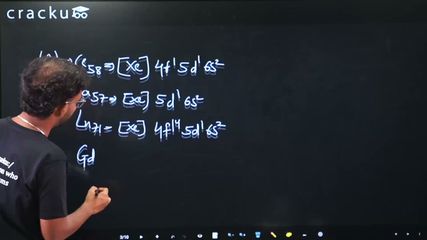
The electronic configurations of the lanthanoids are:
Ce (Z = 58): [Xe] 4f$$^1$$ 5d$$^1$$ 6s$$^2$$
La (Z = 57): [Xe] 5d$$^1$$ 6s$$^2$$ (no 4f electrons)
Lu (Z = 71): [Xe] 4f$$^{14}$$ 5d$$^1$$ 6s$$^2$$
Gd (Z = 64): [Xe] 4f$$^7$$ 5d$$^1$$ 6s$$^2$$
Lanthanoids tend to show +3 as the most stable oxidation state. However, deviation occurs when attaining a particularly stable electronic configuration (empty, half-filled, or fully filled 4f orbitals).
Ce$$^{3+}$$: [Xe] 4f$$^1$$ — By losing one more electron, Ce$$^{4+}$$: [Xe] 4f$$^0$$ achieves a noble gas configuration (empty 4f). This makes Ce$$^{4+}$$ quite stable, so Ce easily deviates to +4 oxidation state.
La$$^{3+}$$: [Xe] 4f$$^0$$ — already has empty 4f, so +3 is very stable. No easy deviation.
Lu$$^{3+}$$: [Xe] 4f$$^{14}$$ — fully filled 4f, so +3 is very stable. No easy deviation.
Gd$$^{3+}$$: [Xe] 4f$$^7$$ — half-filled 4f, so +3 is very stable. No easy deviation.
Cerium (Ce) most easily deviates from the +3 oxidation state because Ce$$^{4+}$$ achieves the very stable empty 4f configuration [Xe] 4f$$^0$$.
Therefore, the correct answer is Option A.
Was this solution helpful?
Click on the Email ☝️ to Watch the Video Solution
Create a FREE account and get:
_1.webp)

Educational materials for JEE preparation

Ask our AI anything

AI can make mistakes. Please verify important information.
AI can make mistakes. Please verify important information.
