
Join Our JEE Preparation Group
Prep with like-minded aspirants; Get access to free daily tests and study material.
Sign in
Please select an account to continue using cracku.in
↓ →
Join Our JEE Preparation Group
Prep with like-minded aspirants; Get access to free daily tests and study material.
The figure given below shows an LCR series circuit with two switches $$S_1$$ and $$S_2$$. When switch $$S_1$$ is closed keeping $$S_2$$ open, the phase difference $$\phi$$ between the current and source voltage is $$30°$$ and phase difference is $$60°$$ when $$S_2$$ is closed keeping $$S_1$$ open. The value of $$(3L_1 - L_2)$$ is _________ H.
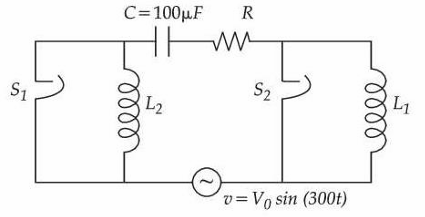
The source voltage is $$v = V_0 \sin 300 t$$, hence the angular frequency of the supply is
$$\omega = 300 \,\text{rad s}^{-1}$$.
The capacitance is given as $$C = 100 \,\mu\text{F} = 1 \times 10^{-4}\,\text{F}$$.
The capacitive reactance is therefore
$$X_C = \frac{1}{\omega C} = \frac{1}{300 \times 1 \times 10^{-4}} = 33.33 \,\Omega$$.
Let the resistance in the series circuit be $$R$$ (it remains the same in both cases).
For an LCR series circuit the phase angle $$\phi$$ between source voltage and current is given by
$$\tan\phi = \frac{X_L - X_C}{R} = \frac{\omega L - X_C}{R}\,\,\,\, -(1)$$
Switch $$S_1$$ closed (inductance $$L_1$$ active) and $$S_2$$ open gives $$\phi_1 = 30^\circ$$.
Using $$(1)$$:
$$\tan 30^\circ = \frac{\omega L_1 - X_C}{R}$$
$$\frac{1}{\sqrt 3} = \frac{\omega L_1 - X_C}{R}$$
$$R = \sqrt 3\;(\omega L_1 - X_C)\,\,\,\, -(2)$$
Switch $$S_2$$ closed (inductance $$L_2$$ active) and $$S_1$$ open gives $$\phi_2 = 60^\circ$$.
Again using $$(1)$$:
$$\tan 60^\circ = \frac{\omega L_2 - X_C}{R}$$
$$\sqrt 3 = \frac{\omega L_2 - X_C}{R}$$
$$R = \frac{\omega L_2 - X_C}{\sqrt 3}\,\,\,\, -(3)$$
Equate the two expressions for $$R$$ from $$(2)$$ and $$(3)$$:
$$\sqrt 3\,(\omega L_1 - X_C) \;=\; \frac{\omega L_2 - X_C}{\sqrt 3}$$
Multiplying by $$\sqrt 3$$,
$$3(\omega L_1 - X_C) = \omega L_2 - X_C$$
$$3\omega L_1 - \omega L_2 = 2X_C$$
$$\omega\,(3L_1 - L_2) = 2X_C\,\,\,\, -(4)$$
Substitute $$X_C = \dfrac{1}{\omega C}$$ into $$(4)$$:
$$\omega\,(3L_1 - L_2) = \frac{2}{\omega C}$$
$$3L_1 - L_2 = \frac{2}{\omega^2 C}$$
Insert the numerical values $$\omega = 300\,\text{rad s}^{-1}$$ and $$C = 1 \times 10^{-4}\,\text{F}$$:
$$\omega^2 = (300)^2 = 90000$$
$$\omega^2 C = 90000 \times 1 \times 10^{-4} = 9$$
Hence
$$3L_1 - L_2 = \frac{2}{9}\,\text{H}$$
Therefore, the required value is $$\dfrac{2}{9}\,\text{H}$$.
Option B which is: $$\dfrac{2}{9}$$
Was this solution helpful?
Create a FREE account and get:
_1.webp)

Educational materials for JEE preparation

Ask our AI anything

AI can make mistakes. Please verify important information.
AI can make mistakes. Please verify important information.
