Join Our JEE Preparation Group
Prep with like-minded aspirants; Get access to free daily tests and study material.
Sign in
Please select an account to continue using cracku.in
↓ →
Join Our JEE Preparation Group
Prep with like-minded aspirants; Get access to free daily tests and study material.
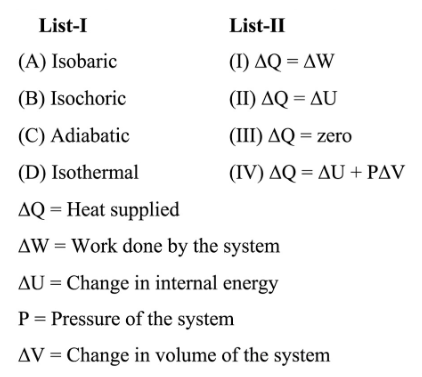
The first law of thermodynamics for a quasi-static process is written as $$\Delta Q = \Delta U + \Delta W$$, where $$\Delta W$$ is the work done by the gas.
For expansion/compression work at constant external pressure, $$\Delta W = P\,\Delta V$$, so the first law becomes $$\Delta Q = \Delta U + P\,\Delta V$$ $$-(1)$$.
Now analyse each process in List-I.
Case A: Isobaric (constant pressure)
Pressure stays constant, therefore $$P = \text{constant}$$. Substituting in $$(1)$$ gives
$$\Delta Q = \Delta U + P\,\Delta V$$.
This is exactly the expression in List-II (IV). Hence A → IV.
Case B: Isochoric (constant volume)
Here $$\Delta V = 0$$, so no work is done: $$\Delta W = P\,\Delta V = 0$$.
Using the first law: $$\Delta Q = \Delta U + 0 \; \Rightarrow \; \Delta Q = \Delta U$$.
This matches List-II (II). Hence B → II.
Case C: Adiabatic (no heat exchange)
By definition, $$\Delta Q = 0$$ for an adiabatic process.
Thus the relation in List-II (III) fits. Hence C → III.
Case D: Isothermal (constant temperature)
For an ideal gas, internal energy depends only on temperature. Since temperature is constant,
$$\Delta U = 0$$.
First law then gives $$\Delta Q = \Delta W$$.
This is relation (I) in List-II. Hence D → I.
Collecting the matches: (A-IV), (B-II), (C-III), (D-I).
The option with this sequence is Option C.
Final Answer: Option C
Was this solution helpful?
Create a FREE account and get:
_1.webp)

Educational materials for JEE preparation

Ask our AI anything

AI can make mistakes. Please verify important information.
AI can make mistakes. Please verify important information.