
Join Our JEE Preparation Group
Prep with like-minded aspirants; Get access to free daily tests and study material.
Sign in
Please select an account to continue using cracku.in
↓ →
Join Our JEE Preparation Group
Prep with like-minded aspirants; Get access to free daily tests and study material.
Consider a circuit consisting of a capacitor (20 $$\mu$$F), resistor (100 $$\Omega$$) and two identical diodes as shown in figure. The resistance of diode under forward biasing condition is 10 $$\Omega$$. The time constant of the circuit is $$\alpha \times 10^{-3}$$ s. The value of $$\alpha$$ is :
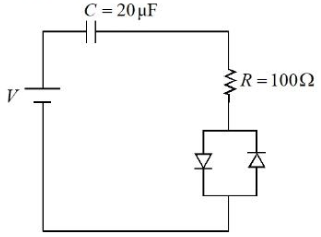
The time constant of an $$RC$$ network is given by
$$\tau = R_{\text{eq}}\,C$$
where
• $$C$$ is the capacitance, and
• $$R_{\text{eq}}$$ is the net resistance actually present in the current path that charges / discharges the capacitor.
Data from the problem:
• Capacitor: $$C = 20 \,\mu\text{F} = 20 \times 10^{-6}\,\text{F}$$
• Fixed resistor: $$R = 100\,\Omega$$
• Two identical diodes whose forward (dynamic) resistance is $$r_d = 10\,\Omega$$ each.
Because the two diodes are connected with opposite orientation (as is usual in such clipping / rectifying circuits), only one diode is forward-biased at any instant. Hence, along the conduction path there is:
$$R_{\text{eq}} = R + r_d = 100\,\Omega + 10\,\Omega = 110\,\Omega$$
Therefore, the time constant becomes
$$\tau = R_{\text{eq}}\,C = 110\,\Omega \times 20 \times 10^{-6}\,\text{F}$$
$$\tau = 2200 \times 10^{-6}\,\text{s} = 2.2 \times 10^{-3}\,\text{s}$$
Comparing with $$\tau = \alpha \times 10^{-3}\,\text{s}$$, we get
$$\alpha = 2.2$$
Hence, the correct choice is
Option A which is: $$2.2$$
Was this solution helpful?
Click on the Email ☝️ to Watch the Video Solution
Create a FREE account and get:
_1.webp)

Educational materials for JEE preparation

Ask our AI anything

AI can make mistakes. Please verify important information.
AI can make mistakes. Please verify important information.


