
Join Our JEE Preparation Group
Prep with like-minded aspirants; Get access to free daily tests and study material.
Sign in
Please select an account to continue using cracku.in
↓ →
Join Our JEE Preparation Group
Prep with like-minded aspirants; Get access to free daily tests and study material.
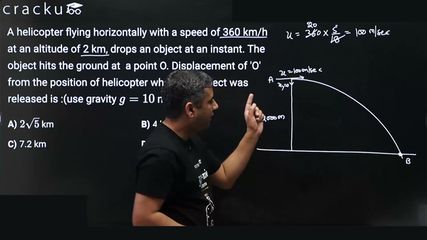
A helicopter flying horizontally with a speed of 360 km/h at an altitude of 2 km, drops an object at an instant. The object hits the ground at a point O. Displacement of 'O' from the position of helicopter where the object was released is :(use gravity $$g = 10$$ m/s$$^2$$)
Speed of the helicopter: $$v = 360 \text{ km h}^{-1} = 360 \times \frac{1000}{3600}\,\text{m s}^{-1} = 100 \,\text{m s}^{-1}$$
Altitude from which the object is released: $$h = 2 \text{ km} = 2000 \text{ m}$$
Time taken by the object to fall through $$h$$ (free-fall, neglecting air resistance) is obtained from $$h = \frac12 \, g t^{2} \; \Longrightarrow \; t = \sqrt{\frac{2h}{g}}$$
Substituting $$h = 2000 \text{ m}$$ and $$g = 10 \text{ m s}^{-2}$$, $$t = \sqrt{\frac{2 \times 2000}{10}} = \sqrt{400} = 20 \text{ s}$$
Thus the object reaches the ground exactly $$20 \text{ s}$$ after it is dropped.
Horizontal distance travelled in this time by either the helicopter or the object is $$x = v t = 100 \,\text{m s}^{-1} \times 20 \text{ s} = 2000 \text{ m} = 2 \text{ km}$$
Vertical distance descended by the object is the full altitude, i.e. $$y = 2 \text{ km}$$ downward.
Hence the displacement vector of the object, measured from the point of release on the helicopter, has components horizontal $$2 \text{ km}$$ and vertical $$2 \text{ km}$$. Its magnitude is $$\sqrt{(2\text{ km})^{2} + (2\text{ km})^{2}} = 2\sqrt{2}\ \text{km}$$
Therefore, the required displacement is $$2\sqrt{2}$$ km.
Option D.
Was this solution helpful?
Click on the Email ☝️ to Watch the Video Solution
Create a FREE account and get:
_1.webp)

Educational materials for JEE preparation

Ask our AI anything

AI can make mistakes. Please verify important information.
AI can make mistakes. Please verify important information.
