
Join Our JEE Preparation Group
Prep with like-minded aspirants; Get access to free daily tests and study material.
Sign in
Please select an account to continue using cracku.in
↓ →
Join Our JEE Preparation Group
Prep with like-minded aspirants; Get access to free daily tests and study material.
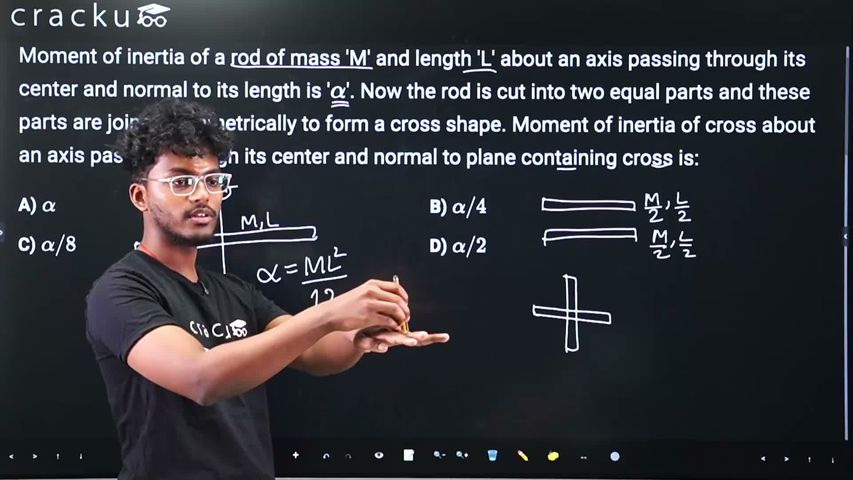
Moment of inertia of a rod of mass 'M' and length 'L' about an axis passing through its center and normal to its length is '$$\alpha$$'. Now the rod is cut into two equal parts and these parts are joined symmetrically to form a cross shape. Moment of inertia of cross about an axis passing through its center and normal to plane containing cross is:
The given rod has mass $$M$$ and length $$L$$. For a slender rod, the moment of inertia about an axis passing through its centre and perpendicular to its length is
$$I = \frac{1}{12}\,M\,L^{2}$$
The question denotes this value by $$\alpha$$, so write
$$\alpha = \frac{1}{12}\,M\,L^{2} \; \; -(1)$$
Next, cut the rod into two equal parts. Each part therefore has
length $$=\frac{L}{2}$$
mass $$=\frac{M}{2}$$
These two half-rods are joined at right angles through their centres to form a symmetric cross (a ‘+’ shape). The required axis passes through the common centre and is perpendicular to the plane of the cross.
For one half-rod of length $$\tfrac{L}{2}$$, the moment of inertia about this axis is again given by the same formula $$I=\tfrac{1}{12}ML^{2}$$ with $$M \rightarrow \frac{M}{2}$$ and $$L \rightarrow \frac{L}{2}$$:
$$I_{\text{one half}} = \frac{1}{12}\left(\frac{M}{2}\right)\left(\frac{L}{2}\right)^{2} = \frac{1}{12}\,\frac{M}{2}\,\frac{L^{2}}{4} = \frac{M\,L^{2}}{96}$$
The cross consists of two such identical half-rods, so total moment of inertia is
$$I_{\text{cross}} = 2 \times \frac{M\,L^{2}}{96} = \frac{M\,L^{2}}{48}$$
From $$(1)$$ we have $$M\,L^{2} = 12\,\alpha$$. Substituting this into the above result:
$$I_{\text{cross}} = \frac{12\,\alpha}{48} = \frac{\alpha}{4}$$
Hence, the moment of inertia of the cross about the stated axis is $$\alpha/4$$.
Answer: Option B $$(\alpha/4)$$
Was this solution helpful?
Click on the Email ☝️ to Watch the Video Solution
Create a FREE account and get:
_1.webp)

Educational materials for JEE preparation

Ask our AI anything

AI can make mistakes. Please verify important information.
AI can make mistakes. Please verify important information.


