
Join Our JEE Preparation Group
Prep with like-minded aspirants; Get access to free daily tests and study material.
Sign in
Please select an account to continue using cracku.in
↓ →
Join Our JEE Preparation Group
Prep with like-minded aspirants; Get access to free daily tests and study material.
In the following reactions, P, Q, R, and S are the major products.
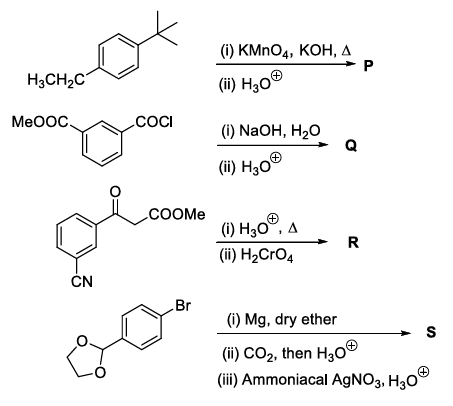
The correct statement(s) about P, Q, R, and S is (are)
Step-1 : Identification of the products P, Q, R and S from the reaction scheme given in the question.
(i) The first reaction is the hydroxylation of ethene with cold, dilute alkaline $$KMnO_4$$ (Baeyer’s reagent). The double bond is converted into a cis-vicinal diol:
$$CH_2 = CH_2 \;\xrightarrow[\text{cold}]{KMnO_4/OH^-}\; HO-CH_2-CH_2-OH$$
Hence, $$P = HO-CH_2-CH_2-OH$$ (ethylene glycol).
(ii) The second reaction is vigorous oxidation of o-xylene with hot alkaline $$KMnO_4$$ followed by acidification. Both benzylic methyl groups are oxidised to carboxyl groups giving phthalic acid:
$$o\text{-}CH_3C_6H_4CH_3 \;\xrightarrow[\text{heat}]{KMnO_4}\; HOOC-C_6H_4-COOH$$
Hence, $$Q = HOOC-C_6H_4-COOH$$ (phthalic acid).
(iii) The third reaction is the dehydrogenation of 1-propanol over copper at 523 K. Primary alcohols give the corresponding aldehydes under these conditions:
$$CH_3CH_2CH_2OH \;\xrightarrow{Cu/523\,K}\; CH_3CH_2CHO$$
Hence, $$R = CH_3CH_2CHO$$ (propanal).
(iv) The fourth reaction is the Rosenmund reduction of benzoyl chloride, or an equivalent route that stops at the aldehyde stage. Thus the product is benzaldehyde:
$$C_6H_5COCl \;\xrightarrow{H_2/Pd\,\,\text{(poisoned)}}\; C_6H_5CHO$$
Hence, $$S = C_6H_5CHO$$ (benzaldehyde).
Step-2 : Verification of the statements.
Option A : Ethylene glycol (P) and phthalic acid (Q) are indeed used as monomers for polyester formation.
• Dacron (polyethylene terephthalate) is obtained from ethylene glycol and terephthalic acid.
• Glyptal is obtained from ethylene glycol and phthalic acid.
Therefore, Option A is correct.
Option B : P, Q and R are claimed to be dicarboxylic acids.
• P is a di-alcohol (diol), not a diacid.
• R is an aldehyde, not an acid.
Hence Option B is wrong.
Option C : “Compounds Q and R are the same.”
Q is phthalic acid (aromatic diacid) whereas R is propanal (aliphatic aldehyde). They are completely different. Option C is wrong.
Option D :
• R (propanal) possesses α-hydrogen atoms, so it undergoes aldol condensation in the presence of base. The statement “R does not undergo aldol condensation” is false.
• S (benzaldehyde) has no α-hydrogen atoms and therefore readily undergoes the Cannizzaro reaction. The statement “S does not undergo Cannizzaro reaction” is also false.
Hence Option D is wrong.
Step-3 : Conclusion.
Only Option A is correct.
Final answer : Option A which is: P and Q are monomers of polymers dacron and glyptal, respectively.
Was this solution helpful?
Create a FREE account and get:
_1.webp)

Educational materials for JEE preparation

Ask our AI anything

AI can make mistakes. Please verify important information.
AI can make mistakes. Please verify important information.


