
Join Our JEE Preparation Group
Prep with like-minded aspirants; Get access to free daily tests and study material.
Sign in
Please select an account to continue using cracku.in
↓ →
Join Our JEE Preparation Group
Prep with like-minded aspirants; Get access to free daily tests and study material.
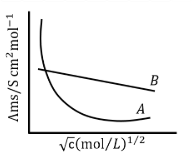
Following figure shows dependence of molar conductance of two electrolytes on concentration. $$\Lambda^0_m$$ is the limiting molar conductivity.
The number of Incorrect statement(s) from the following is ______
(A) $$\Lambda^0_m$$ for electrolyte A is obtained by extrapolation
(B) For electrolyte B, $$\Lambda_m$$ Vs $$\sqrt{c}$$ graph is a straight line with intercept equal to $$\Lambda^0_m$$
(C) At infinite dilution, the value of degree of dissociation approach zero for electrolyte B.
(D) $$\Lambda_m$$ for any electrolyte A or B can be calculated using $$\lambda°$$ for individual ions.
Correct Answer: 3
From the graph, Electrolyte B shows a linear variation of molar conductivity ((\Lambda_m)) with (\sqrt{c}), indicating that it is a strong electrolyte. Electrolyte A shows a curved variation, which is characteristic of a weak electrolyte.
For Electrolyte A, the limiting molar conductivity ((\Lambda_m^0)) cannot be obtained by direct extrapolation because the (\Lambda_m) vs. (\sqrt{c}) plot is not linear. Instead, it is determined using Kohlrausch’s law of independent migration of ions. Hence, Statement (A) is incorrect.
For Electrolyte B, the Debye-Hückel-Onsager equation is
$$\Lambda_m=\Lambda_m^0-A\sqrt{c},$$
which represents a straight line with intercept equal to (\Lambda_m^0). Hence, Statement (B) is correct.
A strong electrolyte is almost completely dissociated, and at infinite dilution its degree of dissociation approaches unity, not zero. Therefore, Statement (C) is incorrect.
Kohlrausch’s law allows the calculation of the limiting molar conductivity ((\Lambda_m^0)) from the limiting ionic conductivities ((\lambda^\circ)) of the constituent ions. It cannot be used to determine (\Lambda_m) at any arbitrary concentration. Hence, Statement (D) is incorrect.
Therefore, Statements (A), (C), and (D) are incorrect, while Statement (B) is correct.
Hence, the number of incorrect statements is
$$\boxed{3}.$$
Was this solution helpful?
Create a FREE account and get:
_1.webp)

Educational materials for JEE preparation

Ask our AI anything

AI can make mistakes. Please verify important information.
AI can make mistakes. Please verify important information.
