
Join Our JEE Preparation Group
Prep with like-minded aspirants; Get access to free daily tests and study material.
Sign in
Please select an account to continue using cracku.in
↓ →
Join Our JEE Preparation Group
Prep with like-minded aspirants; Get access to free daily tests and study material.
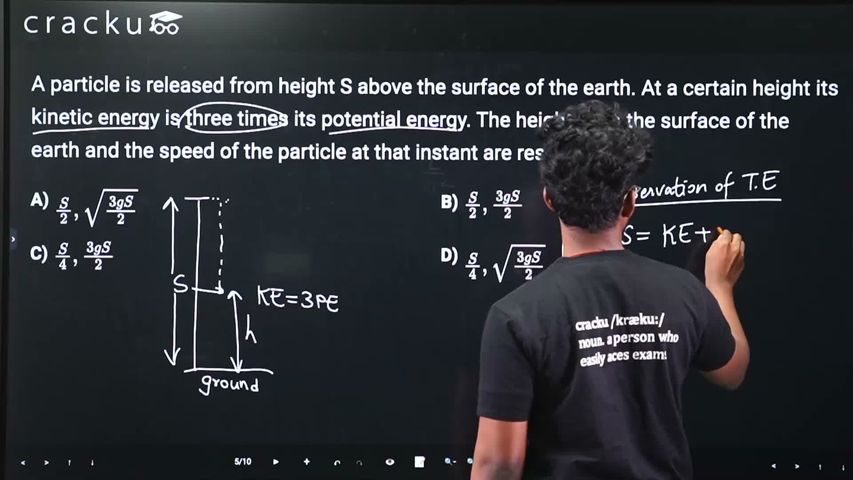
A particle is released from height S above the surface of the earth. At a certain height its kinetic energy is three times its potential energy. The height from the surface of the earth and the speed of the particle at that instant are respectively.
Let the particle be released from rest at height $$S$$ above the earth’s surface. Choose the earth’s surface as the reference level of zero potential energy.
Initial potential energy: $$U_i = mgS$$
Initial kinetic energy: $$K_i = 0$$ (because it is released from rest)
Total mechanical energy remains constant, so for any later instant
$$K + U = mgS$$ $$-(1)$$
At some height $$h$$ (measured from the surface) the kinetic energy is given to be three times the potential energy:
$$K = 3U$$ $$-(2)$$
Let the potential energy at this instant be $$U = mgh$$.
Using $$-(2)$$, the kinetic energy at the same instant is
$$K = 3mgh$$.
Substitute these values of $$K$$ and $$U$$ into the energy conservation equation $$-(1)$$:
$$3mgh + mgh = mgS$$
$$4mgh = mgS$$
$$h = \frac{S}{4}$$.
Now compute the speed. Kinetic energy at height $$h$$ is also $$K = \frac12 mv^2$$. Equate this with $$3mgh$$:
$$\frac12 mv^2 = 3mgh$$
$$v^2 = 6gh$$
Insert $$h = \frac{S}{4}$$:
$$v^2 = 6g\left(\frac{S}{4}\right) = \frac{3gS}{2}$$
$$v = \sqrt{\frac{3gS}{2}}$$.
Therefore, the height of the particle above the earth’s surface and its speed at that instant are
$$h = \frac{S}{4}, \qquad v = \sqrt{\frac{3gS}{2}}$$.
Hence, the correct option is Option D.
Was this solution helpful?
Click on the Email ☝️ to Watch the Video Solution
Create a FREE account and get:
_1.webp)

Educational materials for JEE preparation

Ask our AI anything

AI can make mistakes. Please verify important information.
AI can make mistakes. Please verify important information.


