
Join Our JEE Preparation Group
Prep with like-minded aspirants; Get access to free daily tests and study material.
Sign in
Please select an account to continue using cracku.in
↓ →
Join Our JEE Preparation Group
Prep with like-minded aspirants; Get access to free daily tests and study material.
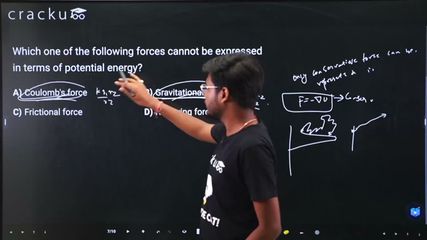
Potential energy $$U$$ is defined only for conservative forces. A conservative force satisfies the following statements:
• Work done by the force depends only on the initial and final positions, not on the actual path.
• For a conservative force $$\vec F_c$$ we can write $$\vec F_c = -\,\boldsymbol{\nabla} U$$, that is, the force equals the negative gradient of a scalar potential energy function $$U(x,y,z)$$.
Let us analyse each force in the options.
Case A: Coulomb’s force between two point charges is $$\vec F = k\,\frac{q_1 q_2}{r^2}\,\hat r$$. It is inverse-square and central, hence conservative. We can define the electrostatic potential energy $$U = k\,\dfrac{q_1 q_2}{r}$$ such that $$\vec F = -\,\dfrac{dU}{dr}\,\hat r$$. Therefore it can be expressed in terms of potential energy.
Case B: Gravitational force between two masses is $$\vec F = -G\,\dfrac{m_1 m_2}{r^2}\,\hat r$$, which is also inverse-square and conservative. The corresponding potential energy is $$U = -G\,\dfrac{m_1 m_2}{r}$$. Hence gravitational force is expressible through potential energy.
Case C: Frictional force (kinetic or static) depends on the nature of surfaces and usually acts opposite to the direction of motion or impending motion. Work done against friction depends on the path length, not merely on initial and final positions. Therefore friction is a non-conservative force. For a non-conservative force we cannot define a single-valued scalar function $$U$$ satisfying $$\vec F = -\,\boldsymbol{\nabla} U$$. So friction cannot be expressed in terms of potential energy.
Case D: A restoring force such as the spring force is $$\vec F = -k\,x\,\hat i$$. It is conservative; its potential energy is the elastic potential energy $$U = \tfrac12 k x^2$$ because $$\vec F = -\,\dfrac{dU}{dx}\,\hat i$$.
Only the frictional force fails to meet the criteria for conservative forces.
Hence the force that cannot be expressed in terms of potential energy is the frictional force → Option C (Option 3).
Was this solution helpful?
Click on the Email ☝️ to Watch the Video Solution
Create a FREE account and get:
_1.webp)

Educational materials for JEE preparation

Ask our AI anything

AI can make mistakes. Please verify important information.
AI can make mistakes. Please verify important information.
