
Join Our JEE Preparation Group
Prep with like-minded aspirants; Get access to free daily tests and study material.
Sign in
Please select an account to continue using cracku.in
↓ →
Join Our JEE Preparation Group
Prep with like-minded aspirants; Get access to free daily tests and study material.
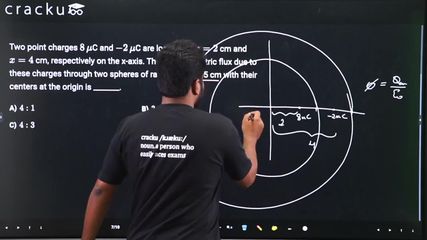
Two point charges $$8\,\mu$$C and $$-2\,\mu$$C are located at $$x = 2$$ cm and $$x = 4$$ cm, respectively on the x-axis. The ratio of electric flux due to these charges through two spheres of radii 3 cm and 5 cm with their centers at the origin is _______.
The electric flux $$\Phi$$ through any closed surface is given by Gauss’s law:
$$\Phi = \frac{Q_{\text{enc}}}{\varepsilon_{0}}$$ where $$Q_{\text{enc}}$$ is the net charge enclosed by the surface and $$\varepsilon_{0}$$ is permittivity of free space.
Because $$\varepsilon_{0}$$ is the same for both spheres, the ratio of fluxes equals the ratio of the enclosed charges.
Sphere of radius 3 cm
Distance of each charge from the origin:$$8\,\mu{\rm C}$$ at $$x = 2\text{ cm}$$ (inside, since $$2 \lt 3$$),
$$-2\,\mu{\rm C}$$ at $$x = 4\text{ cm}$$ (outside, since $$4 \gt 3$$).
Net charge enclosed: $$Q_{3} = 8\,\mu{\rm C}$$.
Sphere of radius 5 cm
Both charges lie within 5 cm of the origin (2 cm and 4 cm), so
Net charge enclosed: $$Q_{5} = 8\,\mu{\rm C} + (-2\,\mu{\rm C}) = 6\,\mu{\rm C}$$.
Therefore, ratio of electric fluxes
$$\frac{\Phi_{3}}{\Phi_{5}} = \frac{Q_{3}}{Q_{5}} = \frac{8\,\mu{\rm C}}{6\,\mu{\rm C}} = \frac{4}{3}.$$
Hence the required ratio is $$4 : 3$$.
Option C which is: $$4 : 3$$.
Was this solution helpful?
Click on the Email ☝️ to Watch the Video Solution
Create a FREE account and get:
_1.webp)

Educational materials for JEE preparation

Ask our AI anything

AI can make mistakes. Please verify important information.
AI can make mistakes. Please verify important information.
