
Join Our JEE Preparation Group
Prep with like-minded aspirants; Get access to free daily tests and study material.
Sign in
Please select an account to continue using cracku.in
↓ →
Join Our JEE Preparation Group
Prep with like-minded aspirants; Get access to free daily tests and study material.
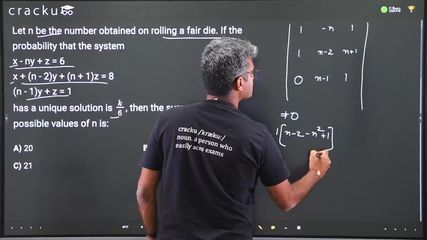
Let $$n$$ be the number obtained on rolling a fair die. If the probability that the system
$$x - ny + z = 6$$
$$x + (n - 2)y + (n + 1)z = 8$$
$$(n - 1)y + z = 1$$
has a unique solution is $$\frac{k}{6}$$, then the sum of $$k$$ and all possible values of $$n$$ is:
We seek the values of n—obtained by rolling a fair die, so that n ∈ {1,2,3,4,5,6}—for which the system of equations
$$x - ny + z = 6,$$ $$x + (n-2)\,y + (n+1)\,z = 8,$$ $$(n-1)\,y + z = 1$$
has a unique solution. A linear system is uniquely solvable exactly when the determinant of its coefficient matrix is nonzero. The coefficient matrix here is
$$D = \begin{vmatrix} 1 & -n & 1 \\ 1 & n-2 & n+1 \\ 0 & n-1 & 1 \end{vmatrix}.$$
Expanding this determinant along the first row gives
$$D = 1\cdot\begin{vmatrix}n-2 & n+1 \\ n-1 & 1\end{vmatrix} \;-\;(-n)\cdot\begin{vmatrix}1 & n+1 \\ 0 & 1\end{vmatrix} \;+\;1\cdot\begin{vmatrix}1 & n-2 \\ 0 & n-1\end{vmatrix}.$$
Each of the 2×2 determinants evaluates as follows:
First minor:
$$(n-2)\cdot1 - (n+1)(n-1) = n - 2 - (n^2 - 1) = -n^2 + n - 1;$$
Second minor:
$$1\cdot1 - (n+1)\cdot0 = 1;$$
Third minor:
$$1\cdot(n-1) - (n-2)\cdot0 = n - 1.$$
Substituting these into the expansion yields
$$D = 1\cdot(-n^2 + n - 1) + n\cdot1 + 1\cdot(n-1) = -n^2 + n - 1 + n + n - 1 = -n^2 + 3n - 2.$$
Factoring shows
$$D = -\bigl(n^2 - 3n + 2\bigr) = -(n - 1)(n - 2).$$
Hence the determinant is nonzero precisely when n ≠ 1 and n ≠ 2. Since a fair die roll gives n ∈ {1,2,3,4,5,6}, the system has a unique solution exactly for n ∈ {3,4,5,6}, which comprises 4 out of the 6 equally likely outcomes. The probability is therefore 4/6, which we write as k/6, giving k = 4.
Finally, summing k and all possible values of n that yield a unique solution gives
$$k + 3 + 4 + 5 + 6 = 4 + 18 = 22.$$
Hence the correct answer is 22.
Was this solution helpful?
Click on the Email ☝️ to Watch the Video Solution
Create a FREE account and get:
_1.webp)

Educational materials for JEE preparation

Ask our AI anything

AI can make mistakes. Please verify important information.
AI can make mistakes. Please verify important information.
