
Join Our JEE Preparation Group
Prep with like-minded aspirants; Get access to free daily tests and study material.
Sign in
Please select an account to continue using cracku.in
↓ →
Join Our JEE Preparation Group
Prep with like-minded aspirants; Get access to free daily tests and study material.
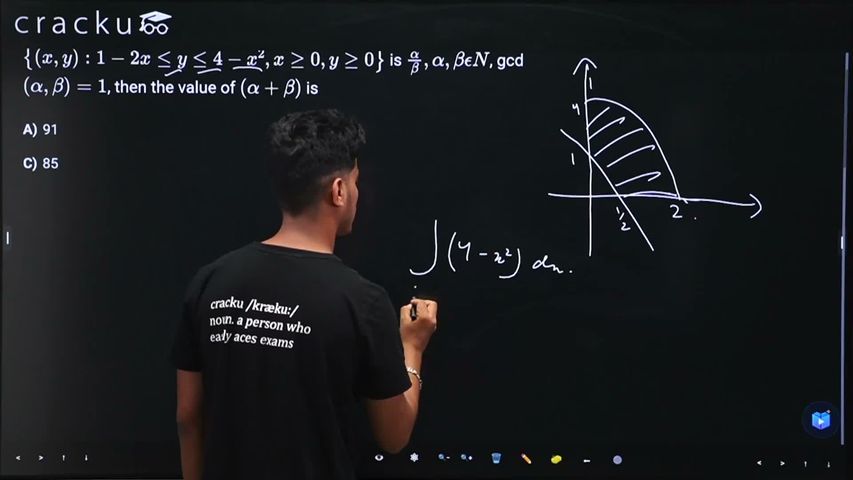
If the area of the region $$\left\{\left(x,y\right): 1-2x \leq y \leq4-x^{2}, x\geq 0, y\geq0 \right\}$$ is $$\frac{\alpha}{\beta} , \alpha,\beta \epsilon N$$, gcd $$\left(\alpha,\beta\right)=1$$, then the value of $$\left(\alpha+\beta\right)$$ is
For any fixed $$x$$ we need the lower bound to be non-negative: $$1-2x \ge 0 \; \Rightarrow \; x \le \tfrac12$$. Thus the line contributes only on $$0 \le x \le \tfrac12$$. Beyond $$x = \tfrac12$$ the constraint $$y \ge 0$$ replaces the lower curve by the $$x$$-axis $$y = 0$$.
Hence split the region into two vertical strips:
Case 1: $$0 \le x \le \tfrac12$$, $$y$$ runs from $$1-2x$$ up to $$4 - x^{2}$$.
Case 2: $$\tfrac12 \le x \le 2$$ (where the parabola is still above the $$x$$-axis), $$y$$ runs from $$0$$ up to $$4 - x^{2}$$.
The total area $$A$$ is therefore
$$A = \int_{0}^{1/2}\!\!\left[(4 - x^{2}) - (1 - 2x)\right]\,dx \;+\; \int_{1/2}^{2}\!\!(4 - x^{2})\,dx \;.$$
Compute the first integral:
$$\int_{0}^{1/2}\!(3 + 2x - x^{2})\,dx = \Bigl[3x + x^{2} - \tfrac{x^{3}}{3}\Bigr]_{0}^{1/2} = 3\!\left(\tfrac12\right) + \left(\tfrac12\right)^{2} - \tfrac{(1/2)^{3}}{3} = \tfrac{3}{2} + \tfrac14 - \tfrac{1}{24} = \tfrac{41}{24}\;.$$
Compute the second integral:
$$\int_{1/2}^{2}\!(4 - x^{2})\,dx
= \Bigl[4x - \tfrac{x^{3}}{3}\Bigr]_{1/2}^{2}
= \left(8 - \tfrac{8}{3}\right) - \left(2 - \tfrac{1}{24}\right)
= \tfrac{16}{3} - \tfrac{47}{24}
= \tfrac{81}{24}
= \tfrac{27}{8}\;.$$
$$A = \tfrac{41}{24} + \tfrac{27}{8} = \tfrac{41}{24} + \tfrac{81}{24} = \tfrac{122}{24} = \tfrac{61}{12}.$$
Thus $$\alpha = 61,\; \beta = 12,$$ with $$\gcd(\alpha,\beta)=1,$$
$$\alpha + \beta = 61 + 12 = 73.$$ Option D
Was this solution helpful?
Click on the Email ☝️ to Watch the Video Solution
Create a FREE account and get:
_1.webp)

Educational materials for JEE preparation

Ask our AI anything

AI can make mistakes. Please verify important information.
AI can make mistakes. Please verify important information.
